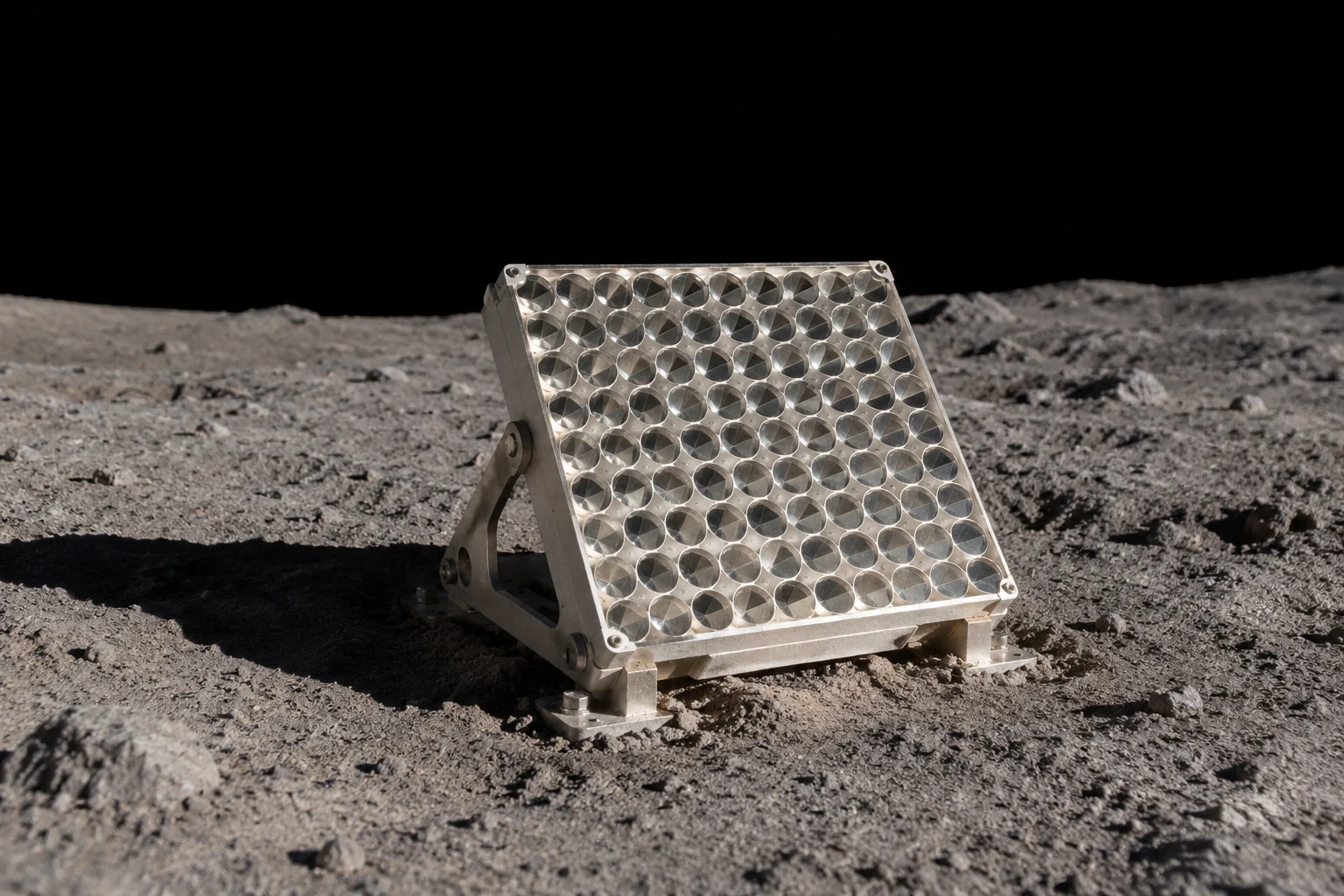
The first successful laser return from the Apollo 11 reflector reached California’s Lick Observatory on August 1, 1969. Less than two weeks earlier, astronauts had left a panel about 46 centimetres square at Tranquility Base. Nothing on that panel had to receive a radio command or look for California in the lunar sky. An observatory on Earth sent a short pulse of light and timed the faint return. The trip took about two and a half seconds. Turning that interval into a precise distance took work at both ends of the calculation, even though the equipment on the Moon sat still on the ground.[1, 2]
The little mirrors that send light home
Picture an ordinary flat mirror on a wall. Shine a light straight at it and the reflection comes back toward you. Tilt the mirror slightly and the reflected light heads off to one side. A corner-cube reflector uses three mutually perpendicular reflecting faces, arranged like the floor and two walls in the corner of a room. Following three reflections, an incoming ray travels back in the opposite direction. There is a range of angles over which this works, so an individual cube does not need to be pointed at one particular Earth telescope with the precision a flat mirror would demand.[1, 4]
The original Apollo 11 panel held one hundred of those small reflectors. The panel is entirely passive. The observatory supplies the light, records the departure time and looks for returning photons. From the Moon’s end, nothing has to switch on at the right moment. That division of labour gives the experiment an unusual lifespan. Researchers can change the laser, detector, clock and analysis methods on Earth and keep using the same optical reference point that earlier observers measured decades ago.[1, 2, 4]
What two and a half seconds buys you
In a first calculation, take the speed of light as 300,000 kilometres per second and multiply it by 2.5 seconds. The pulse covered about 750,000 kilometres. Divide by two for the outward and return journeys and you get a one-way distance of roughly 375,000 kilometres. A different measured time gives a different range. Even a difference of a thousandth of a second corresponds to about 150 kilometres in this two-way calculation. A clock displaying just seconds and milliseconds would miss most of the detail lunar ranging teams are after.[1, 2]
There is another subtlety hiding in the everyday question of how far away the Moon is. The distance in that calculation starts at a telescope on Earth’s surface and ends at a particular reflector on the Moon’s surface. It is different from the distance between the centres of the two bodies. As Earth turns, the observatory moves. The Moon travels along its orbit and the orientation of its surface relative to the observer changes a little, too. A date, a time, a station and a reflector all belong with a measurement if someone is to interpret it later.[2, 3, 4]
Even the air above the telescope counts as part of the path. Light travels a little more slowly through air than through a vacuum. For a reflector low above the horizon, the light crosses more atmosphere than for one nearly overhead. Ranging calculations account for that extra delay before comparing observations made from different directions.[2, 3]
Finding a few photons among all the others
A beam that looks narrow across an observatory spreads during its trip to the Moon. Only a small part of the light illuminates the reflector. Of the light returned toward Earth, only a small part enters the receiving telescope. The observer cannot simply look through an eyepiece and watch the lunar panel flash. The task is to pick out exceptionally faint returns against other photons reaching the detector, including light from the bright lunar surface around the target. A large telescope helps both to direct the outgoing beam and to collect the returning light.[2, 4]
Knowing approximately where and when to look is an enormous advantage. The astronomers already have a model of the orbit and know the reflector’s location. They aim at the predicted spot and look for detections close to the expected return time. Across repeated shots, genuine returns group near the predicted delay. A stray photon might fall in the same window by chance. What matters is the pattern of detections, together with the timing and calibration information that gives the pattern physical meaning.[2, 3]
The team at Apache Point Observatory in New Mexico combines individual photon measurements into observations called normal points. This lets people working on the lunar orbit use a carefully reduced measurement representing a period of observation. Averaging can narrow the scatter of many photon arrivals, but it cannot resolve a timing offset shared by all those arrivals. To see why, imagine a clock that adds exactly the same extra delay to every round trip. More successful shots would make the estimate more consistent while preserving the error. Independent calibration earns its place alongside photon counting.[2, 3]
How a changing distance reveals a slowly receding Moon
Pick two nights at random and one range may be smaller than the other. The Moon’s orbit is elliptical, and the telescope has changed position with the turning Earth. Those changes easily overshadow the few centimetres by which the Moon’s orbit grows in a year. The long record lets researchers compare observations taken at many orbital phases against a model of those repeating motions. It is the trend left over across years of observations that reveals the slow outward drift. A pair of dates and a subtraction would make a poor substitute.[2, 4, 5]
The drift, around four centimetres per year at present, is linked to tides. The Moon pulls on Earth, including its oceans. Earth’s rotation and the time required for water to respond mean the tidal mass is slightly out of alignment with the Moon. Its gravitational pull transfers angular momentum from Earth’s rotation to the lunar orbit. A tiny change in the average separation accumulates over many years. One pulse measures a light-travel time. A long series, referred back to known places on Earth and the Moon, measures something an astronaut could never see by simply watching the horizon at Tranquility Base.[4, 5]
Related reading
Sources
- National Institute of Standards and Technology — To the Moon and Back in 2.5 Seconds
- Apache Point Observatory — Lunar laser ranging
- APOLLO team — Fifteen years of lunar ranging, data reduction and calibration
- NASA — Laser Beams Reflected Between Earth and Moon Boost Science
- NASA Science — Tidal locking
Keep exploring.
We’ll email you when the first edition is ready.
Last updated November 26, 2026.

Barnakle Editorial Team
Barnakle Editorial Team is the collective byline used for Barnakle’s editorial articles. The contributor profile explains the team identity and links to the publication’s editorial policies.
More from the editorial team →