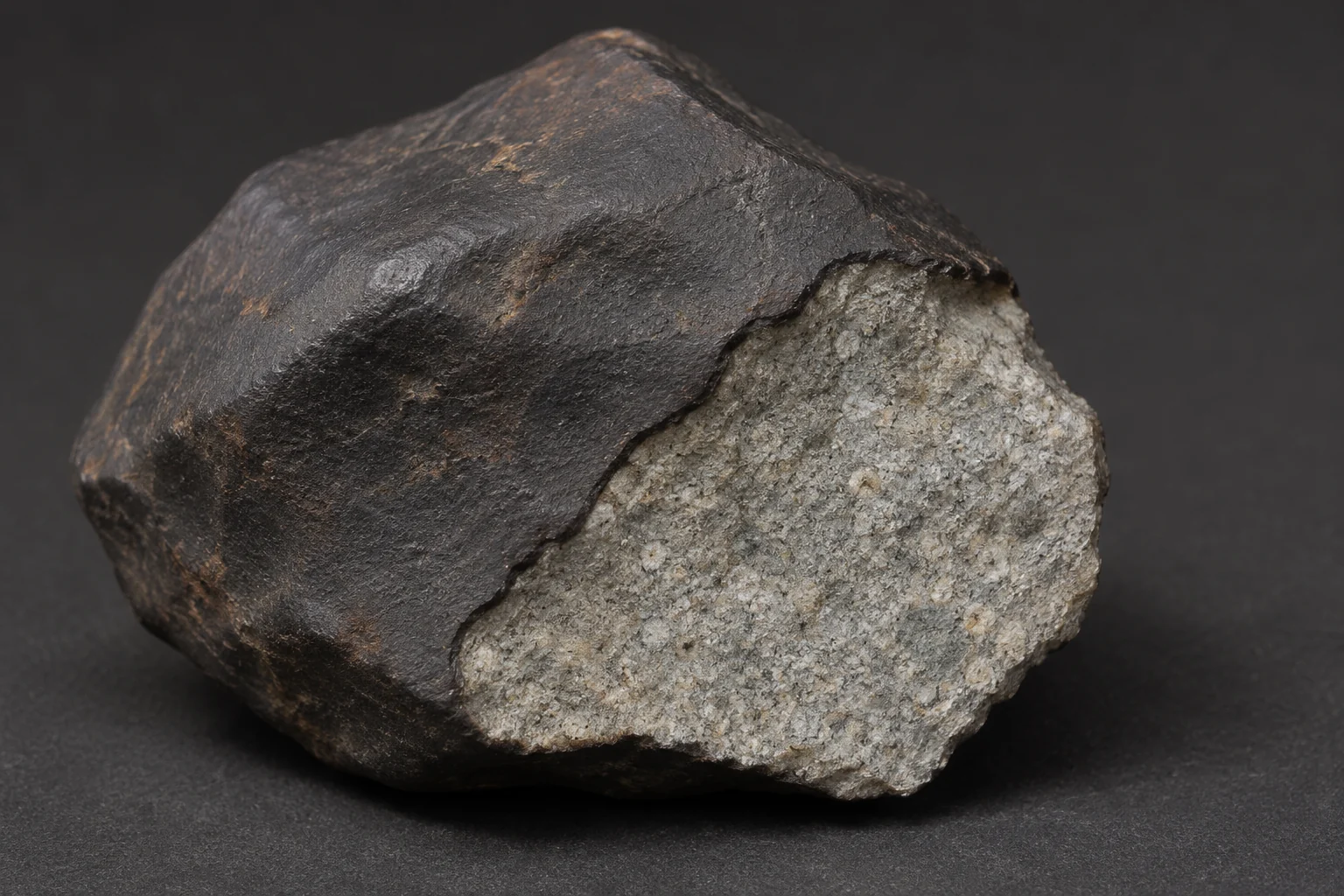
On the Modoc meteorite displayed by the American Museum of Natural History, a broken face exposes pale stone beside a dark outside skin. The two surfaces belong to the same rock. The pale interior preserves material that survived the descent, while the rind records just the final part of the rock’s passage through Earth’s air. Called fusion crust, the rind forms when surface material melts and the last melt left on the stone solidifies. Its thinness is as important a clue to the process as its colour.[1, 2, 3]
A surface that keeps disappearing
A space rock approaching Earth carries energy because of its enormous speed relative to the atmosphere. It compresses and heats the air in front of it. Energy transferred to the rock is concentrated at the exposed surface, where material can melt and be stripped away. The loss of material during passage is called ablation. The surface facing the air at one instant may be gone a moment later. It follows that the crust we eventually hold cannot be a record of every millimetre that melted during the flight. Much of that material went elsewhere.[1, 2, 5]
The distinction is easiest to see at a broken edge. Imagine that a rock lost several millimetres of material on its way down and was left with a dark rind only a fraction of a millimetre thick. Those two numbers describe different things. One compares the earlier size with the later size. The other measures the melt that survived on the final surface. You could measure the skin very accurately under a microscope and still have too little information to reconstruct the original size of the incoming object.[2, 3, 5]
Heat also takes time to travel inward through solid rock. During the brief period of severe surface heating, melt can be removed faster than heat penetrates deeply. As the surviving stone loses speed, the energy delivered by the flow falls and the remaining melt cools. A stony meteorite can therefore have a thin, intensely altered outside and a largely unmelted interior. A black rind around a pale face need never have been a whole glowing stone cooling from the outside in.[1, 2, 3]
What makes the crust dark?
On many freshly fallen stony meteorites, the crust is dark brown or black. Rapid cooling can leave glass, and iron-bearing minerals such as magnetite contribute to the colour. A freshly broken surface through the same stone can reveal mineral grains, flecks of metal or small rounded structures called chondrules, depending on the type of meteorite. The molten outer layer has partly destroyed or concealed those original textures. An investigator asking about the parent rock and one asking about atmospheric entry have good reasons to look at different parts of the specimen.[1, 3, 4, 5]
The surface may look rather dull. The word glass describes how some of the material solidified. It promises no particular polish on a hand specimen with a rough or weathered exterior. Nor will the contrast always be as dramatic as at Modoc. A naturally dark interior beneath a dark fusion crust can make the boundary harder to see in a photograph. The place where a broken or cut face intersects an intact outer surface is often much more informative than either face viewed straight on.[1, 3, 4]
A streak can preserve which way the air flowed
Some meteorites present a relatively stable face to the oncoming air for part of the descent. Melt pushed along the surface can leave narrow ridges when it freezes. The American Museum of Natural History points to these flow lines on the Stannern meteorite. Following their paths can give evidence about the direction material travelled across the stone. It is a particularly intimate record of flight: the streak sits where material moved over an object that had no fixed up or down during most of its earlier journey through space.[1, 4]
Other marks tell different stories. Broad, thumb-shaped depressions known as regmaglypts result from uneven removal of material. A raised flow line and a shallow depression can both affect the outline of a shadow under a museum light, but a closer view distinguishes material left behind in a ridge from a hollow cut into the object. Neither feature occurs in an equally clear form on every meteorite. A neatly shaped, oriented example in a display represents one particularly legible flight history among many more irregular ones.[1, 2, 4]
What a filmed fireball added at Winchcombe
The Winchcombe meteorite fell in Gloucestershire, England, in 2021. Cameras recorded the fireball, and researchers were able to study recovered stones as well as the recordings. Under the microscope, the crust included crystals of olivine in glassy material alongside magnetite and cavities left by gas. Beneath the melted exterior the team observed abundant cracks related to water loss from heated minerals. A section through the edge showed much more than a simple boundary between black and grey.[5]
The researchers proposed that a weakened layer could shed small pieces during deceleration, helping to explain bursts visible in fireball footage. The value of that comparison is easy to miss. A film can tell scientists that something changed during flight without uniquely identifying the material responsible. A crack in a recovered stone gives physical evidence of a change without recording its time on a clock. Examining both records lets researchers test a proposed sequence against observations at two radically different scales.[5]
How much can an outside surface tell you?
Time on Earth changes the evidence again. Oxidation and weathering can turn a surface rusty brown, and abrasion can remove pieces of crust. Conversely, ordinary terrestrial rocks and industrial materials can have dark skins or glassy surfaces. A photograph showing only a black exterior provides little basis for confidently identifying a meteorite. A documented fall, the material inside, the character of the boundary and laboratory analysis can all contribute evidence that colour cannot supply by itself.[2, 3, 4]
The next time you pass a meteorite case, look for a piece displayed with its broken edge facing you. Move your attention from the much older grains inside to the thin layer wrapped over the edge. In the distance of a millimetre you may be crossing from evidence about the rock’s life before Earth to the physical record of its arrival here.[1, 2, 5]
Related reading
Sources
- American Museum of Natural History — What does a meteorite look like?
- Oxford University Museum of Natural History — Meteorites
- Washington University in St. Louis — Meteorite fusion crust
- Arizona State University — Meteorite characteristics
- Meteoritics & Planetary Science — Fusion crust of the Winchcombe meteorite
Keep exploring.
One remarkable idea at a time—nature, science, history and beyond.
Last updated November 23, 2026.

Barnakle Editorial Team
Barnakle Editorial Team is the collective byline used for Barnakle’s editorial articles. The contributor profile explains the team identity and links to the publication’s editorial policies.
More from the editorial team →