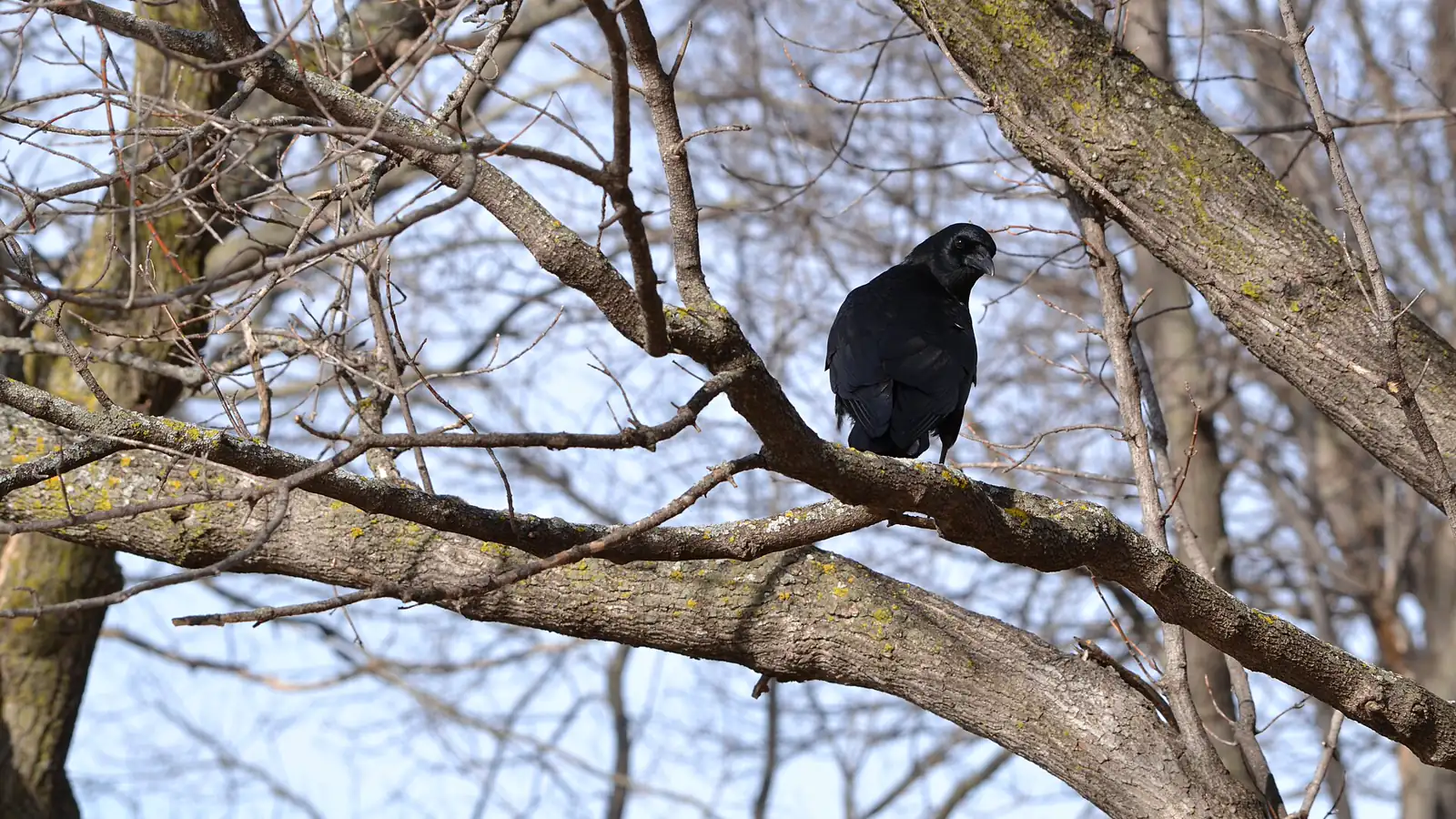
Wild American crows can learn to distinguish a face associated with capture from other faces. Experiments using masks have also shown that responses can spread to birds that did not directly experience the original capture. The findings connect individual memory with social learning in a shared environment.
They do not require crows to think about people in exactly the way people think about one another.
Masks separate the face from the wearer
If a crow reacts to one researcher, it might be recognising clothing, movement or the person's usual location. A mask lets researchers present the same facial appearance on different people and compare it with another appearance.
In studies near Seattle, investigators wore a distinctive mask while capturing, banding and releasing crows. Later presentations tested whether birds responded selectively to that mask. The method made a learned visual association more testable than a story about one bird disliking one person.
A dangerous association can persist
Previously captured birds could scold the face associated with capture on later encounters. Continued observations showed lasting recognition over the study period rather than only a brief reaction immediately after release.
Persistence is important, but it should be reported with the conditions and duration actually measured. A memorable study does not establish that every crow remembers every human face for life or recognises people without error.
Other birds can acquire the response
The social-learning research tracked how scolding spread among American crows. Birds can gain information by observing others, including through mobbing responses in which several animals react to a perceived threat.
A bird that has not been captured need not independently discover the risk from scratch. This creates a route through which a local group can accumulate information about a repeatedly encountered stimulus.
Social learning is not a spoken warning label
A crow's call and behaviour may direct attention and influence another bird's response. The evidence does not show birds exchanging human-style sentences containing a person's identity and an account of past events.
Likewise, calling the response a “grudge” can be a useful informal metaphor, but it introduces an emotional interpretation beyond the behavioural measurement. The demonstrated result is selective responding based on experience and information from others.
Brain studies ask a different question
University of Washington research also examined responses to faces associated with capture and with care. Such work investigates the neural systems involved in processing socially meaningful stimuli.
Neural activity can complement behavioural evidence, but it does not give direct access to a crow's subjective thoughts. A response resembling a familiar human pattern is not proof of an identical experience.
What these experiments change
The work shows that a human encounter can become part of a wild bird population's learned environment. Recognition, memory and social context all matter. It also demonstrates why controlled comparisons are more informative than assuming an unusually persistent crow is merely reacting to whatever person happens to be nearby.
Explore a related question
Why Birds See Colors Humans Cannot
Sources and further reading
Keep exploring.
One remarkable idea at a time—nature, science, history and beyond.
Last updated October 27, 2026.

Barnakle Editorial Team
Barnakle Editorial Team is the collective byline used for Barnakle’s editorial articles. The contributor profile explains the team identity and links to the publication’s editorial policies.
More from the editorial team →