Lagrange points are locations associated with the motion of two large bodies, such as the Sun and Earth. In a reference frame rotating with that pair, a small object can maintain a particular geometric relationship to them under idealised conditions.
The points are useful for spacecraft planning, but they are not places where gravity disappears. Nor do they all hold objects stably without correction.
The rotating frame explains the balance
A spacecraft near a Lagrange point is still moving through space. Describing the point as fixed refers to the frame that rotates with the larger bodies. Their combined gravity and the orbital motion permit the special configuration.
There are five points in the idealised circular restricted three-body model. Naming the two-body system matters: Sun–Earth L2 is not the same location as Earth–Moon L2.
L1 and L2 provide useful geometry
Sun–Earth L1 lies between Earth and the Sun. A spacecraft near it can be positioned well for solar and solar-wind observations. L2 lies beyond Earth, away from the Sun, providing geometry useful for some astronomical observatories.
The scientific advantage comes from the environment and viewing arrangement, not from placing the spacecraft at an absolute standstill. Communications, thermal design and the desired observing direction all influence the mission choice.
The first three points are unstable
L1, L2 and L3 lie along the line through the large bodies and are unstable equilibria. Small departures can grow, so a spacecraft using the region needs a suitable trajectory and periodic corrections.
NASA's JPL glossary explicitly distinguishes the L1 and L2 locations and their need for adjustment. A description such as “gravitational parking spot” is helpful only if it does not suggest a permanently self-correcting orbit.
Spacecraft usually loop around the region
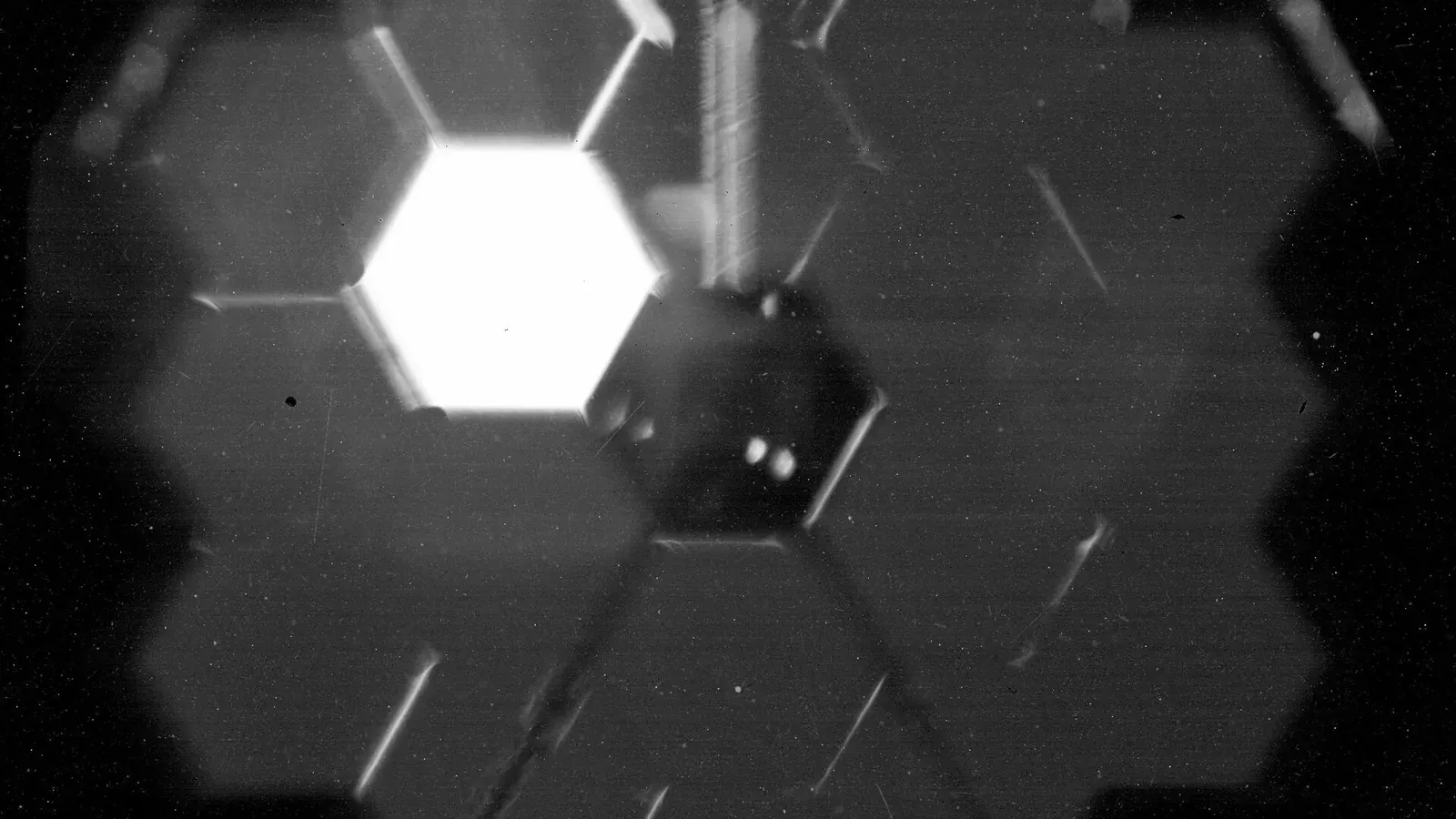
Missions often use halo or related trajectories around a Lagrange-point region rather than sit exactly on the mathematical point. Webb's trajectory around Sun–Earth L2 is one example.
NASA's account of Webb's arrival describes station-keeping as part of continued operation. Orbiting an unstable region and remaining near it are compatible when the flight team makes the required corrections.
L4 and L5 have different stability properties
The remaining points form triangular configurations with the two larger bodies. In the idealised model they can be stable when the mass ratio meets the necessary condition. Real objects also experience additional gravitational and other disturbances.
This is why a classroom diagram needs context before being used to predict the lifetime of a real asteroid or spacecraft orbit.
Useful does not mean effortless
A mission still needs to reach its operational trajectory, control its attitude, communicate and manage its resources. Lagrange-point dynamics can make certain arrangements practical, but they do not remove engineering constraints. Their importance is that orbital mechanics supplies distinctive regions in which useful observing geometries can be maintained.
Explore a related question
How Solar Sails Travel Using Light
Sources and further reading
Keep exploring.
One remarkable idea at a time—nature, science, history and beyond.
Last updated October 29, 2026.

Barnakle Editorial Team
Barnakle Editorial Team is the collective byline used for Barnakle’s editorial articles. The contributor profile explains the team identity and links to the publication’s editorial policies.
More from the editorial team →