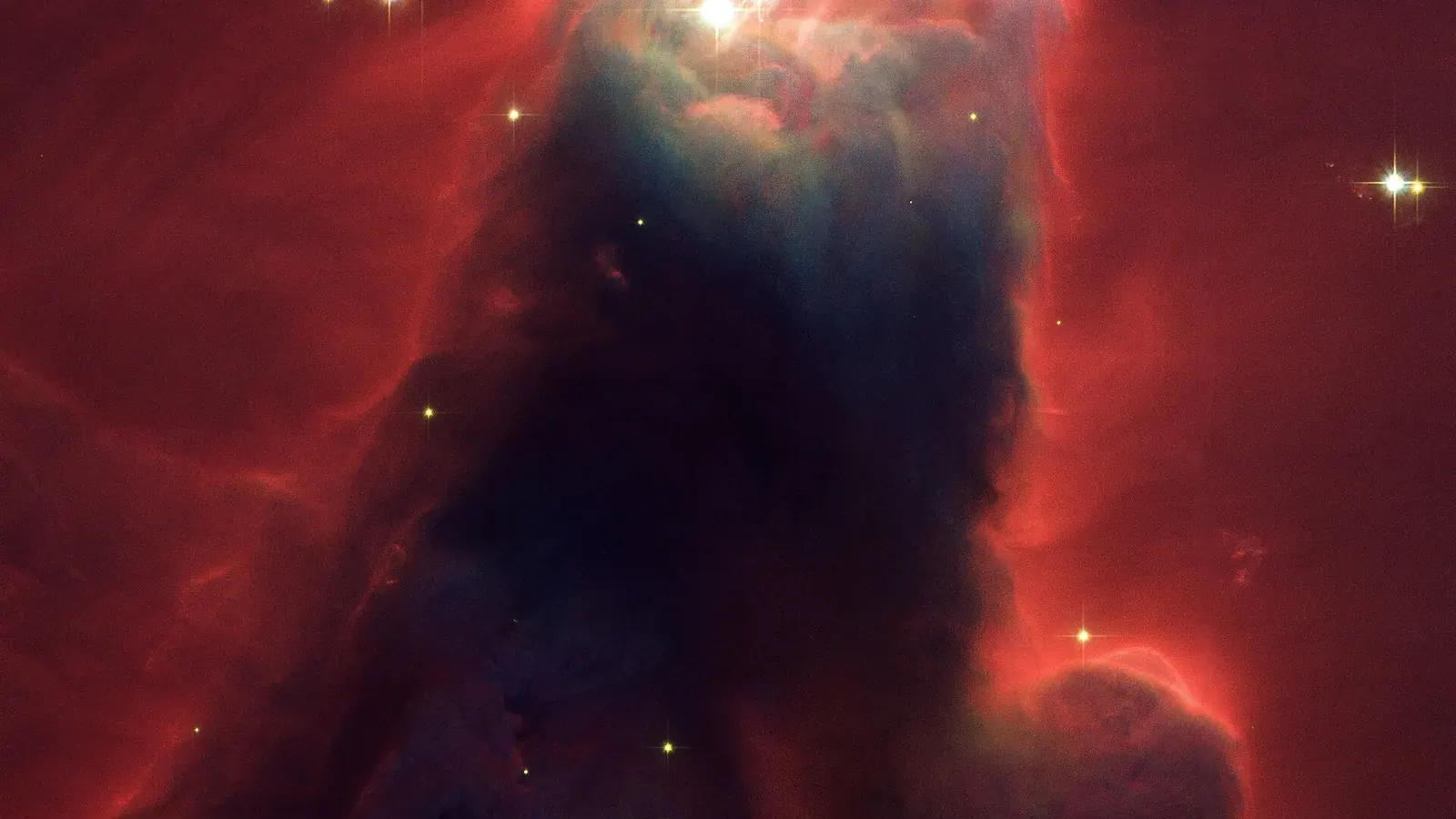
Stars form from interstellar gas and dust, often within dense regions of molecular clouds. Gravity gathers material into a collapsing core, which develops a growing central object called a protostar. Continued accretion and heating can eventually lead to sustained hydrogen fusion if enough mass is assembled.
The process is neither a cloud suddenly catching fire nor a simple fall of all nearby material into one giant star.
Cold gas can still resist collapse
Temperature affects the pressure of a gas, while turbulence, magnetic fields and other motions also influence a cloud. Gravity must compete with those forms of support. Dense regions can collapse while much of the wider cloud remains in a different state.
This helps explain why identifying a molecular cloud does not mean every part of it is actively forming stars. The relevant conditions vary within the same large structure.
Collapse breaks the problem into smaller regions
A giant cloud can contain several dense cores. NASA's star-formation accounts describe many sites of stellar birth within a larger nursery rather than one cloud producing only one object.
Material becoming more concentrated releases gravitational energy. A protostar can consequently shine before it powers itself with sustained hydrogen fusion. Brightness alone is not proof that the main-sequence stage has begun.
Rotation creates a disk and a transport problem
Infalling material usually has angular momentum. A rotating disk can form around the young object, and material must move through that environment to continue feeding it.
Disks, outflows and jets are therefore part of the developing system, not decorative structures added after the star is finished. They also offer observable clues about how growth and the removal of material occur together.
Fusion marks an important transition
If the central object becomes sufficiently hot and dense, sustained hydrogen fusion can provide the energy source characteristic of a main-sequence star. Not every forming object acquires enough mass to follow that path.
The transition depends on the object's mass and evolution. There is no single universal timetable applying equally to every stellar nursery or protostar.
Young stars affect their surroundings
Radiation, winds and outflows can change the cloud that supplied the star. NASA's Webb observations of L1527 illustrate a protostar embedded in material while outflows shape the surrounding region.
These interactions can influence further star formation nearby. A cloud's future is therefore affected by the stars already emerging within it, not only by the conditions that existed before collapse began.
Different wavelengths reveal different stages
Dust can obscure visible light from young objects. Infrared observations help reveal embedded regions and emission from dust, while other measurements probe gas and motion. Some dense regions still block particular infrared wavelengths.
Combining those views lets astronomers test a sequence that cannot be watched from start to finish for an individual star. The emerging picture is built from physics and many objects observed at different stages, with the details of mass assembly still an active field of research.
Explore a related question
How Starlight Reveals the Elements in Distant Suns
Sources and further reading
Keep exploring.
One remarkable idea at a time—nature, science, history and beyond.
Last updated October 27, 2026.

Barnakle Editorial Team
Barnakle Editorial Team is the collective byline used for Barnakle’s editorial articles. The contributor profile explains the team identity and links to the publication’s editorial policies.
More from the editorial team →