Surface tension pulls a flexible film toward the smallest area that can enclose its volume
The short answer
A soap bubble is a sandwich: air, a microscopically thin water-based film and air again. Soap molecules stabilize both surfaces long enough for the film to stretch. Geometry supplies the spherical preference, while pressure, drainage and evaporation determine how the bubble changes and eventually bursts.
Surface molecules experience an imbalance
Molecules inside a liquid are pulled in all directions by neighbours. At a surface, that balance is incomplete, producing an energetic cost per unit area called surface tension.
A sphere minimizes surface area
Among shapes enclosing the same volume, a sphere uses the least area. Reducing area lowers the film’s surface energy, so an unconstrained bubble naturally approaches a sphere.
Soap stabilizes a thin water film
Surfactant molecules gather at the air–water boundaries, lower surface tension and slow rapid rupture. They do not eliminate surface tension; they make a lasting flexible film possible.
Internal pressure holds the film open
Gas pressure inside exceeds outside pressure by an amount related to surface tension and radius. Smaller bubbles require a larger pressure difference than larger ones.
Gravity drains liquid downward
On Earth, liquid flows toward the bottom of a bubble, thinning the upper film. In microgravity, drainage changes and bubbles can remain more uniformly spherical.
Airflow deforms moving bubbles
Drag and pressure differences stretch a bubble passing through air. Once the disturbance weakens, surface tension pulls it back toward a sphere if the film survives.
Contact creates new geometries
A bubble touching a wand, wall or liquid surface shares boundaries and no longer has to remain a complete free sphere. Contact angles reflect competing surface energies.
Bubble clusters form flat boundaries
Neighbouring bubbles press against one another and share films. Equal-sized bubbles meet across flatter walls, while pressure differences curve films toward the larger bubble.
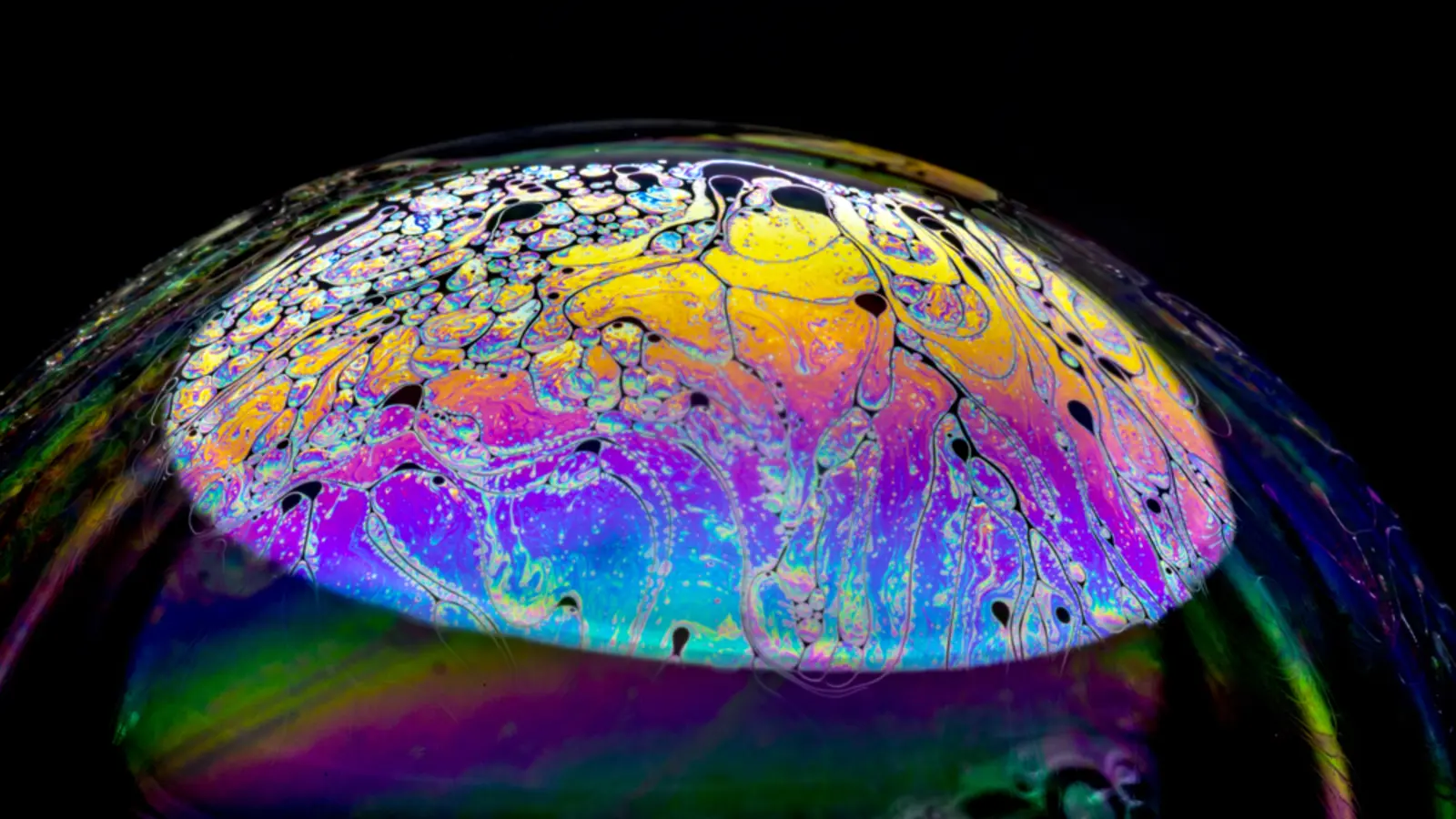
Colour reveals film thickness
Light reflecting from the front and back of the thin film interferes. Changing thickness produces shifting colours and dark patches that can signal imminent rupture.
Common misconceptions
Bubbles are not round because air itself has a round shape or because gravity squeezes them equally. Surface-energy minimization creates the spherical tendency. Soap also does not make water stronger like a solid skin; the film remains liquid and constantly drains, flows and rearranges.
How scientists know
Researchers measure surface tension with force balances and capillary methods, image film thickness through optical interference, track pressure and radius and study bubbles in reduced gravity. Mathematical models use curvature and energy minimization to predict shapes and foam structures.
Why are tiny bubbles more pressurized?
The pressure difference increases as radius decreases for a film with the same surface tension.
Why do bubbles become rainbow-coloured?
Light waves reflected from the film’s two surfaces interfere according to thickness.
Why are foam bubbles not round?
Crowding forces neighbours to share films and form polyhedral shapes.
Why do bubbles pop?
Drainage, evaporation, contamination or disturbance can thin the film until it ruptures.
Are raindrops bubble-shaped?
Small drops are nearly spherical, but large falling drops flatten; they are not classic teardrops.
Key takeaways
- Surface tension minimizes film area.
- A sphere encloses volume with the least area.
- Pressure balances the contracting film.
- Gravity, contact and airflow can distort bubbles.
Continue exploring
A bubble has two interfaces
The thin film has an inner air-water surface and an outer water-air surface. Both contribute surface tension, which is why bubble pressure depends on two contracting boundaries.
Why does a dry finger pop a bubble?
It disrupts the surfactant film and draws or displaces liquid; a wet soapy surface causes less disturbance.
Are bubbles perfect spheres in space?
Free bubbles can become more nearly spherical without gravity-driven drainage, though motion and contact still deform them.
Sources and further reading
Keep exploring.
One remarkable idea at a time—nature, science, history and beyond.
Last updated October 30, 2026.

Barnakle Editorial Team
Barnakle Editorial Team is the collective byline used for Barnakle’s editorial articles. The contributor profile explains the team identity and links to the publication’s editorial policies.
More from the editorial team →