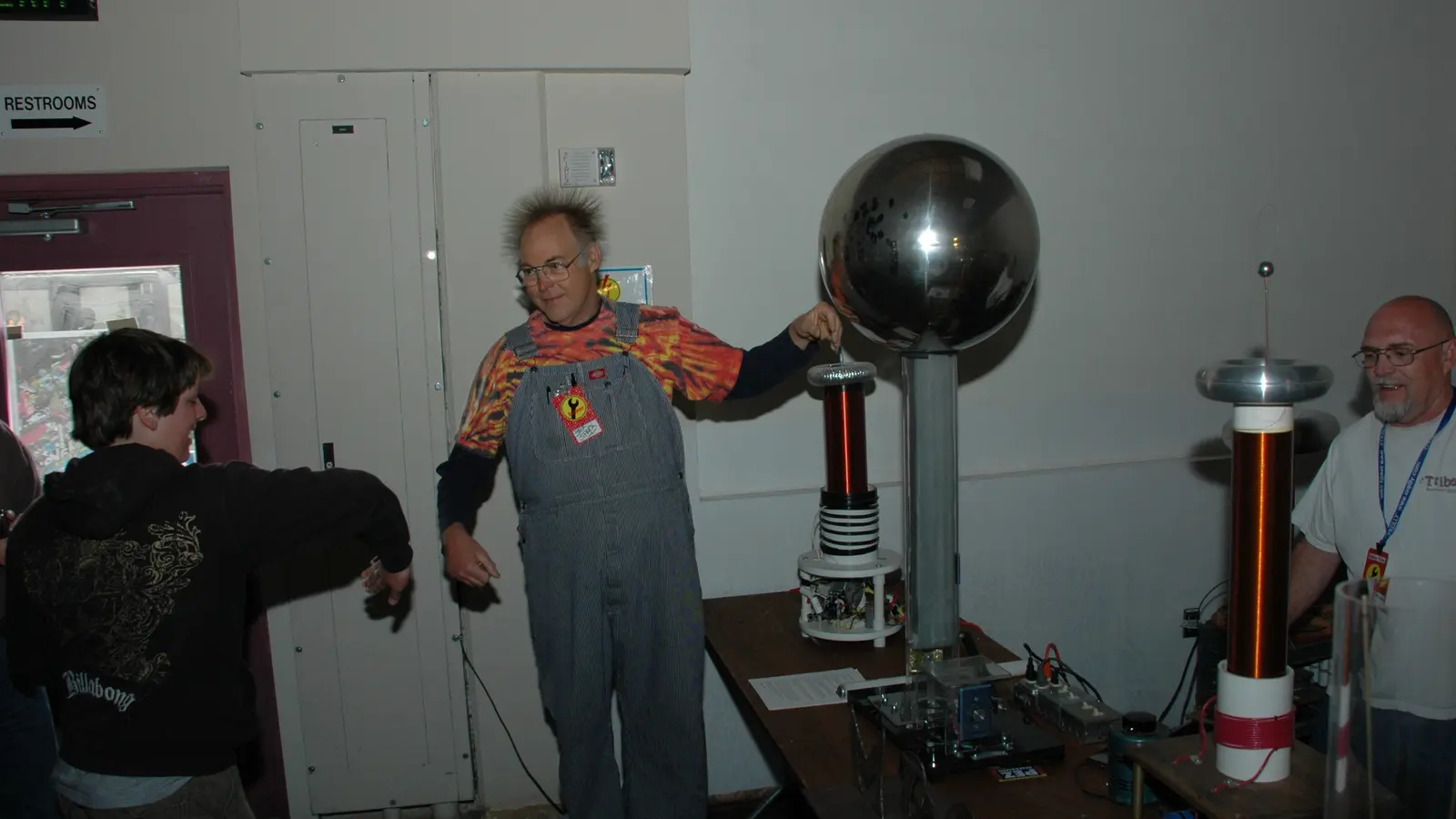
Like electrical charges spread across individual hairs and repel one another
The short answer
The dramatic Van de Graaff demonstration is a visible map of electrical forces. Charge delivered to a person spreads over the body and onto separate hairs. Because the strands are light, flexible and similarly charged, a modest electrostatic force can overcome bending and part of gravity.
Atoms contain positive and negative charge
Protons carry positive charge, electrons carry negative charge and ordinary matter is usually close to neutral. A small imbalance of mobile electrons can nevertheless create noticeable electrical forces.
Contact can transfer electrons
When dissimilar materials touch and separate, their surfaces can exchange charge according to material, cleanliness, pressure and environment. Rubbing repeats and enlarges the contact area.
Like charges repel
Two hairs carrying charge of the same sign experience forces pushing them apart. Many strands arrange themselves to increase separation, producing the familiar radiating pattern.
Opposite charges attract
A charged balloon can polarize or attract hair even when the hair begins neutral. Electrons shift slightly within materials, leaving nearer and farther regions with different effective charge.
Electric fields act without direct contact
A charged object changes the electric field around it. Forces on charges in each hair can lift, bend or orient the strand before it touches the source.
Hair is light and flexible
Electrostatic forces that would barely move a heavy object can easily deflect a fine fibre. Length, stiffness, moisture, oils and styling products influence the visible result.
Dry air prolongs charge
Water molecules adsorbed on surfaces can provide pathways for charge to dissipate. Low humidity reduces that leakage, so winter indoor air often produces stronger shocks and flyaway hair.
A Van de Graaff generator supplies charge continuously
A moving insulating belt transports charge to a metal dome. Touching the dome lets charge spread over a participant while insulation from ground slows discharge.
A spark is a rapid discharge
If the electric field becomes strong enough, air molecules ionize and form a conductive path. Charge then moves suddenly, producing a spark, light, heat and sometimes a sharp sound.
Common misconceptions
Rubbing does not manufacture electrons from nothing; it redistributes existing charge. Hair also does not stand because electricity is flowing continuously like current in a household wire. The visible effect can persist while charge is relatively stationary, then collapse as it leaks away or discharges.
How scientists know
Physicists measure charge with electrometers and Faraday cups, map electric fields, control humidity and compare material pairs. High-speed imaging tracks fibre motion, while Coulomb-force models test how charge, separation, hair stiffness and gravity determine equilibrium shape.
Why is static worse in winter?
Heated indoor air is often dry, so surface charge leaks away more slowly.
Why does a balloon attract hair?
Transferred charge and polarization create an attractive electric force.
Why do all the hairs separate?
Strands carrying like charge repel one another.
What causes the small shock from a doorknob?
A voltage difference ionizes a tiny air path and charge moves rapidly.
Is a classroom Van de Graaff generator safe?
It must be operated under trained supervision and kept away from sensitive electronics and relevant medical devices.
Key takeaways
- Contact and separation can leave hair with net electrical charge.
- Like-charged hairs repel and spread apart.
- Low mass makes strands easy to lift.
- Humidity and grounding allow charge to dissipate.
Continue exploring
Sources and further reading
Keep exploring.
One remarkable idea at a time—nature, science, history and beyond.
Last updated October 30, 2026.

Barnakle Editorial Team
Barnakle Editorial Team is the collective byline used for Barnakle’s editorial articles. The contributor profile explains the team identity and links to the publication’s editorial policies.
More from the editorial team →