The short answer
An avalanche begins when snow loses the support or resistance needed to remain in place on a slope. In a slab avalanche, a cohesive layer of snow sits above a weaker layer or interface. A local failure can spread through that weakness, allowing a much larger slab to break free and move downhill. Loose-snow and glide avalanches start through different mechanisms, so not every avalanche follows the same sequence. [1][4]
The familiar image is a white cloud racing down a mountain. The crucial first events can happen before that cloud exists, inside a snowpack whose layers and bonds are difficult to see from the surface. Understanding those events begins with treating snow as a changing material rather than a uniform blanket.
Snowfall builds a history of layers
A season’s snowpack records successive storms, wind transport, temperature changes, melting and refreezing. Different layers can contain different grain shapes, densities and bond structures. A hard-looking surface does not describe every layer underneath it.
Snow grains also change after they fall. Water vapour moves, crystals grow or round, and bonds between grains evolve. These processes can strengthen some parts of the snowpack while leaving or creating weaknesses elsewhere.
SLF researchers examine the thickness, continuity, strength and variability of those layers because the structure helps determine whether and how avalanches form. A depth measurement alone cannot supply all that information. [2]
What makes a slab different from loose snow
A slab is a sufficiently cohesive layer that can transmit stress across an area. The weak layer beneath it may have a fragile structure or weak bonding. The important combination is the stronger overlying layer and the weakness that can fail below it.
This can seem counterintuitive. Why would relatively well-bonded snow contribute to a dangerous release? Its cohesion allows a large piece to act together rather than every grain immediately moving independently. When its support fails, that connected piece can be released over a broad area. [4]
A slab does not need to be a perfectly rigid plate. Its stiffness, thickness and other properties matter to how it deforms and transfers loads. The word identifies a mechanical role in the snowpack, not a guarantee that the layer resembles a sheet of concrete.
How a small failure becomes a large one
An initial failure in a weak layer is not automatically a full avalanche. For a large slab release, the fracture must be able to propagate far enough. Whether it continues or stops depends on the slab, the weak layer and their spatial variation.
As a portion loses support, the slab deforms and changes the stresses around the failure. That can help the fracture advance into neighbouring material. A comparatively local disturbance can therefore be connected to a release much larger than the initial damaged region.
A field study published in 2023 followed crack-propagation experiments over several weeks. It examined both sustained propagation and crack arrest, illustrating that the transition between them is a measurable physical problem, not simply a matter of assuming every crack runs indefinitely. [3]
Why the crown appears near the top
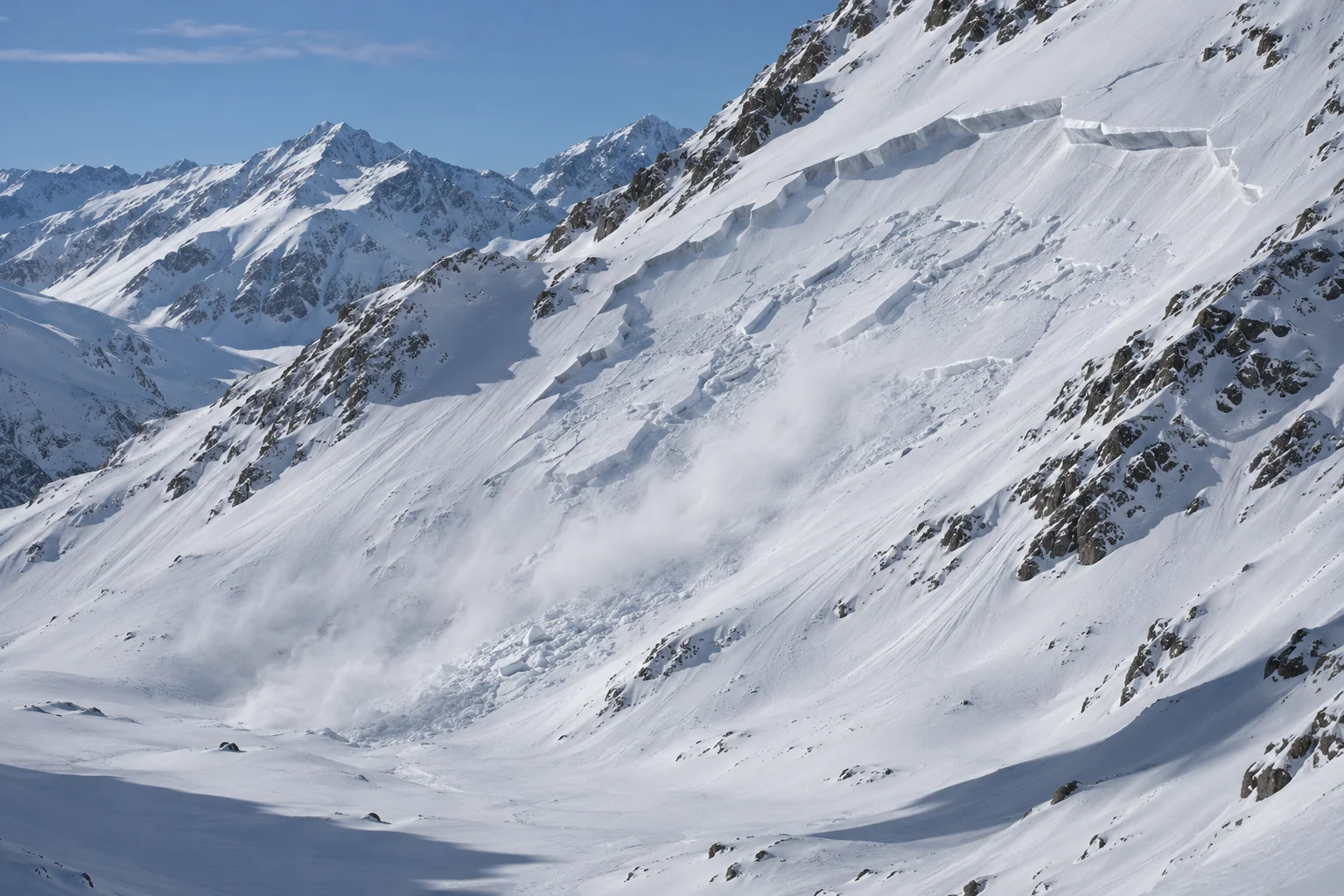
Once the slab is released, it can separate from the surrounding snow through additional fractures. The upper exposed boundary is commonly called the crown. Flanks mark the sides, and the released snow moves over a bed surface.
Those visible boundaries help reconstruct what happened after the event. They do not mean the first failure necessarily began at the crown. The initiating weakness can have been buried, and the fracture can have propagated before the upper break became visible. [5]
This order matters when interpreting a photograph. The most conspicuous feature left behind may be a consequence of the release rather than a picture of the exact first moment. A dramatic surface crack is only one part of a three-dimensional failure.
What supplies the energy for the motion?
Snow resting on a mountainside has gravitational potential energy. Once resistance is overcome and the mass moves downward, some of that energy becomes motion, while other portions are dissipated through deformation, friction and interactions with the surrounding material and air.
The trigger is therefore not required to provide all the energy of the eventual avalanche. A small change can initiate the release of a much larger amount of energy already associated with the elevated snow mass.
This distinction is common in physical systems. Initiating a failure and powering the resulting motion are different roles. Identifying the immediate disturbance does not remove the need to explain the material structure that allowed it to become a large release.
How weather can change the balance
New snowfall can add load. Wind can move snow from one place to another and build locally thicker deposits. Warming and liquid water can change bonds and the mechanical behaviour of layers and interfaces.
These influences interact with the snowpack that is already present. The same amount of new snow can meet different underlying structures on different slopes or at different times. Weather is therefore a major influence without being the only variable.
A slab release can occur well after the most recent snowfall. A buried weak layer may remain relevant while the surface changes. Conversely, a visible blanket of fresh snow does not by itself specify which failure mechanism, if any, will develop. [1]
Loose-snow avalanches begin differently
A loose-snow release starts from a relatively localized point and can fan outward as moving snow entrains more material. It does not require the same broad cohesive slab to detach along a buried weak layer.
That difference helps explain the characteristic fan-shaped track. The moving region grows as it descends, whereas a slab avalanche can begin by releasing a broad connected area. Both may involve many snow grains, but the initiation and early geometry differ. [5]
Wet and dry conditions create further distinctions. Classifying a release by its starting mechanism and by its water content describes different aspects of the same event. “Wet avalanche” and “slab avalanche” are not necessarily mutually exclusive categories.
What liquid water changes
When liquid water moves through snow, it can alter bonds and collect at particular boundaries. Some wet-snow avalanches are associated with warming or rain and can occur as either loose-snow or slab releases.
This does not mean every wet snowpack must immediately avalanche or that every refrozen layer has one fixed effect. The distribution of water, existing structure and evolving temperatures matter. A change in one part of the pack need not describe its entire depth.
Glide avalanches involve another interface: the base of the snowpack against the ground. In those events, the entire snow cover can move over a relatively smooth substrate, with moisture at the ground interface playing an important role. [1]
Where the powder cloud comes from
The large airborne cloud is not a requirement for every avalanche. It develops when enough snow becomes suspended in turbulent air during the motion. Some avalanches have a conspicuous powder component; others move as denser masses with much less airborne display.
A cloud can obscure the snow travelling beneath it. Its outline therefore does not provide a complete measurement of the volume, speed or internal structure of the flow. Visual drama and physical size are related imperfectly.
The same caution applies to comparing events in videos. Camera distance, terrain, snow properties and the stage of the motion all affect appearance. A visually quiet release can still involve a substantial mass; a striking cloud is not a calibrated instrument.
How researchers investigate the first seconds
Scientists combine field measurements, controlled cold-laboratory experiments and numerical models. They can image weak-layer structure, record fracture propagation with high-speed cameras and measure how layers change over time. [2]
Models need those measurements because a simple drawing cannot capture every process. The 2023 crack-propagation study, for example, connected observed motion with estimates of slab and weak-layer properties. Such work helps explain why one crack stops while another continues. [3]
These tools improve understanding without turning a general explainer into a field stability assessment. Decisions about current avalanche exposure require current regional forecast information and appropriate local expertise, rather than an inference from a landscape photograph. [6]
Common questions
### Does every avalanche start as a snowball? No. A slab avalanche can release a broad connected layer after a buried fracture propagates. A rolling ball is not the general starting mechanism.
Can an avalanche begin without a recent storm?
Yes. Existing weak layers and changing conditions can remain relevant after snowfall ends. The current structure and loading history matter together.
Is the powder cloud the whole avalanche?
Not necessarily. A denser moving part can exist beneath or alongside the suspended snow. What the camera sees may represent only one component of the flow.
What is the most useful distinction?
Separate the trigger, the failure mechanism and the subsequent motion. A disturbance starts a process, the snowpack’s structure determines how failure develops, and gravity supplies energy as the released mass descends.
Keep exploring
Sources and further reading
- WSL Institute for Snow and Avalanche Research SLF — Avalanche types
- SLF — Avalanche formation and research methods
- Bergfeld and colleagues (2023) — Crack propagation in a weak snowpack layer: arrest and sustained propagation
- Avalanche Canada — Avalanche and snowpack glossary
- European Avalanche Warning Services — Avalanche terminology
- U.S. National Weather Service — Avalanche safety and regional forecast information
Reference review: November 12, 2026.
Keep exploring.
One remarkable idea at a time—nature, science, history and beyond.
Last updated November 14, 2026.

Barnakle Editorial Team
Barnakle Editorial Team is the collective byline used for Barnakle’s editorial articles. The contributor profile explains the team identity and links to the publication’s editorial policies.
More from the editorial team →