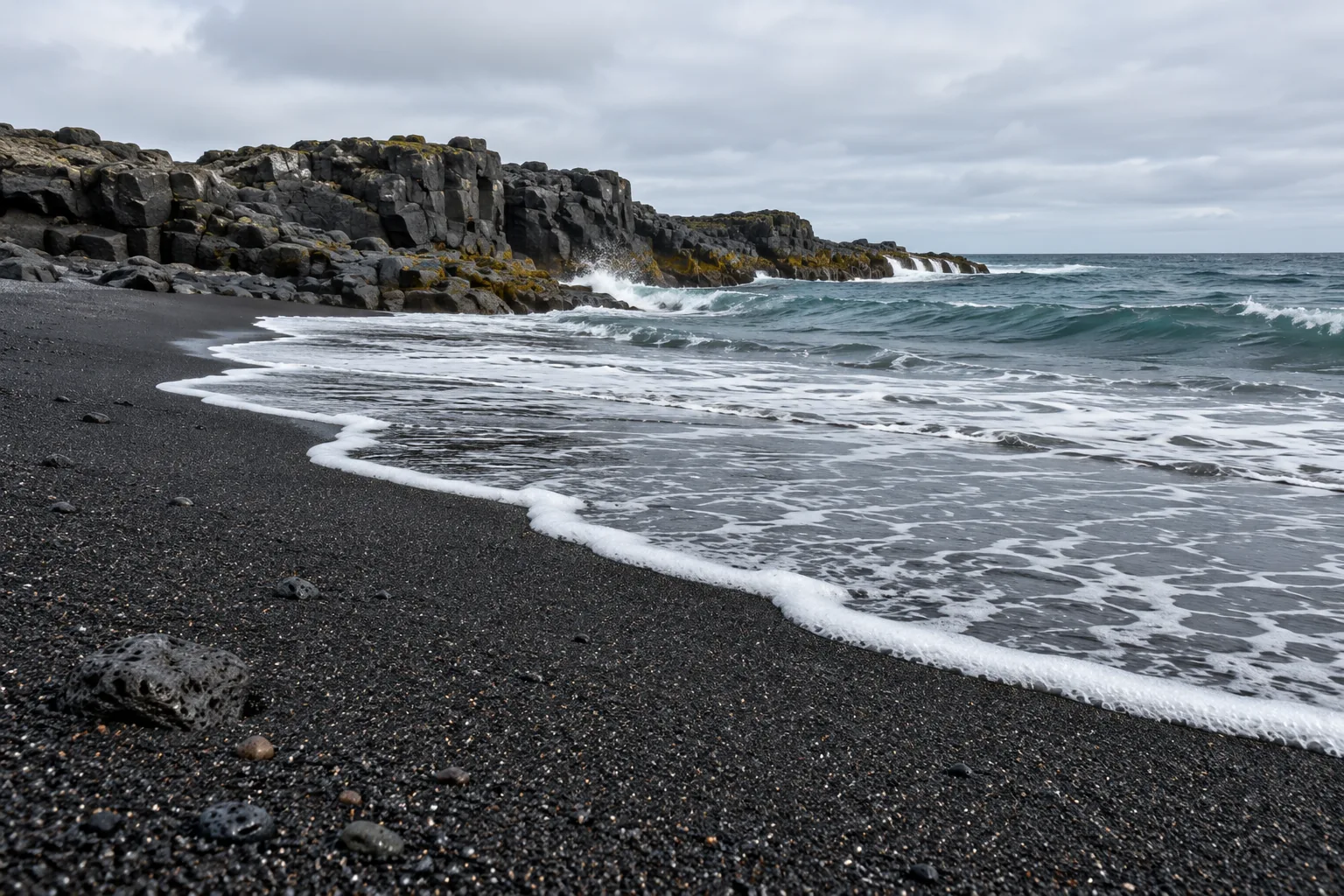
A beach does not have to be pale. Some shorelines are covered in charcoal-coloured grains, while others have narrow black ribbons threaded through otherwise light sand. Both can be natural, but they do not always form in the same way.
Black sand commonly comes from dark volcanic rock and glass, or from concentrations of dark minerals such as magnetite and ilmenite. Erosion supplies the particles, and moving water sorts and redistributes them. The colour is a clue to the material’s origin and journey, rather than proof that a volcano is erupting nearby. [1, 2, 3, 4]
Sand describes a size, not a single substance
When people picture sand, they often imagine small grains of quartz. In sedimentology, however, “sand” is primarily a size category. A grain can be sand-sized whether it consists of quartz, volcanic glass, a different mineral or a fragment produced by a living organism.
The National Park Service’s account of coastal sediment sizes uses the Wentworth classification: sand extends from approximately one-sixteenth of a millimetre to two millimetres. Finer particles fall into other categories, while coarser material becomes gravel. A black pebble and a black sand grain may therefore have similar origins but different size classifications. [1]
This resolves a common confusion. A beach can contain sand without containing much quartz, and “black sand” does not name one mineral. It describes what a mixture looks like at a particular size. Determining the actual material requires looking more closely than its overall colour.
How volcanic rock becomes black sand
Basalt and other dark volcanic materials can supply the grains of a black beach. One pathway begins with solid rock. Weathering, cliff erosion and repeated wave action break that rock into smaller fragments. The fragments can then be transported along the coast or deposited where conditions allow them to accumulate.
Another pathway operates when hot lava meets seawater. Rapid cooling can produce volcanic glass and fragmentation. Waves and currents redistribute the resulting particles, and further abrasion changes them as they move. The National Park Service describes both direct lava–water fragmentation and erosion of hardened volcanic coastline as sources of dark beach material. [2]
The two pathways need not be mutually exclusive. A shoreline can receive new fragments from one event while also reworking older deposits. Its beach may contain both glassy particles and fragments of crystalline volcanic rock. The relative contributions depend on the local geology and sediment supply.
This also means a black beach does not date itself. Dark grains can persist and be moved long after the eruption that created their parent material. Colour alone cannot establish whether the sediment formed yesterday, centuries ago or through repeated reworking of older deposits.
A beach can form rapidly without becoming permanent
USGS observations from Hawaiian ocean entries document black sand associated with lava being quenched and fragmented where it meets the sea. Images and field descriptions show how newly produced fragments can accumulate along parts of a volcanic coastline. [3]
But production is only the beginning. For a beach to remain, its supply and retention have to balance the processes removing material. A pulse of new sediment can build a deposit quickly, while waves and currents later disperse it. A coastline is a moving sediment system, not a display case that preserves every grain where it first arrives.
An imagined bookkeeping exercise helps. Suppose a small bay receives 100 units of dark sediment over a period while 80 units leave. Its stored sediment increases by 20 units. If the incoming supply later falls to 10 while the outgoing amount remains 80, the deposit shrinks. Those units are hypothetical; the point is that a beach’s existence depends on a continuing balance, not only on its original creation.
Why pale beaches sometimes develop black streaks
Some dark bands are concentrations of dense minerals rather than a uniformly volcanic beach. A mixed sediment supply may contain small amounts of magnetite, ilmenite and other minerals alongside more abundant lighter-coloured grains.
Waves can preferentially move grains according to their size, density and shape. Under some conditions, the result is a dark layer or ribbon enriched in heavy minerals. A study of deposits on Fire Island after Hurricane Sandy identified black laminations containing magnetite and ilmenite, with garnet among the other important minerals. The study connected the layers to erosion, transport and hydrodynamic sorting. [4]
That is a different explanation from lava flowing directly into the water. The source rocks can be far inland, and rivers or other sediment pathways can deliver their weathered minerals to the coast. Dark material may then be concentrated where waves repeatedly sort the mixture.
Think of a mixed collection of particles subjected to the same moving water. They need not all accelerate, settle or be carried away at the same rate. Repetition can turn a modest difference in behaviour into a visible band. The result records the sorting conditions as well as the original mineral mixture.
Is all black sand magnetic?
No. Magnetite is a strongly magnetic mineral, and magnetite-rich sand can respond conspicuously to a magnet. A dark grain of volcanic glass is not automatically magnetite, however. Nor does every dark mineral have the same magnetic response.
The National Park Service documents magnetite-rich black streaks in the inland dunes of Great Sand Dunes National Park. Its classroom material uses magnetic separation to illustrate one component of a sand mixture. This is an example of a mineral property providing evidence beyond colour; it is not a test that makes all black sand identical. [5, 8]
Even where collection and testing are allowed, a magnetic response identifies only part of a mixture. A few magnetic grains do not establish that every grain has the same composition. At protected or culturally significant sites, observation and photography can be more appropriate than taking material away.
How waves change the appearance of a beach
Wind, currents and waves continually move coastal sediment. Sorting can leave grains relatively similar in size or produce a mixture that includes a wider range. Changes in wave energy can also change which particles are mobilized and where they settle. [6]
A black layer can therefore become more visible, disappear beneath fresh material or reappear after erosion removes a lighter covering. None of those changes necessarily means the dark grains have changed chemically. The exposed surface may simply be a different slice through an existing deposit.
This is why photographs from different seasons can show different patterns at the same shore. One image records a moment in an evolving system. To explain a change confidently, researchers need information about waves, storms, currents, sediment sources and the shape of the coastline.
Moisture can change appearance too. Wet grains often look darker than dry ones because water changes how light is scattered and reflected. That optical effect changes what the surface looks like; it does not turn a light mineral into a black mineral. Barnakle’s wet-pavement explainer examines the same general distinction between material and appearance.
Black, white, green and pink beaches tell different stories
Beach colour reflects the materials available and the processes concentrating them. NOAA describes black sand from eroded dark volcanic materials and contrasts it with sediments influenced by organisms, including shell-derived grains. The range of colours follows from varied source materials rather than one universal beach-forming recipe. [7]
| What you observe | A possible explanation | What still needs checking |
|---|---|---|
| A largely black beach near volcanic rock | Dark volcanic fragments and glass supply much of the sand. | Which rocks and eruptions supplied it, and how it was transported. |
| Thin black streaks on a pale beach | Waves have concentrated dense dark minerals. | The mineral composition and the sorting conditions. |
| Dark grains attracted to a magnet | Magnetite may be an important component. | What the other grains are and how representative the sample is. |
What scientists look for beyond colour
A useful description includes grain size, shape, composition and sorting. Angular grains can suggest a different transport history from strongly rounded ones, although interpretation depends on the material and local setting. Looking at nearby rocks and possible river sources adds context.
It is helpful to keep the questions separate. “What is this grain?” asks about composition. “Where did it come from?” asks about provenance. “Why is it here?” asks about transport and deposition. One observation may contribute to several answers, but no single colour reliably settles them all.
Questions about black sand beaches
Are black beaches always beside active volcanoes?
No. Older volcanic material can be eroded and reworked, and dark mineral concentrations can form in settings that do not involve a nearby active eruption.
Is black sand pollution?
It can be entirely natural. Colour alone cannot establish either contamination or cleanliness; those questions require evidence about the material and the site.
Can every black sand grain be picked up with a magnet?
No. Magnetite-rich grains can be strongly responsive, while other dark materials behave differently. A beach is usually a mixture.
Why can a black stripe vanish after a storm?
Moving water can redistribute it, bury it or expose a different layer. A change in the visible pattern does not necessarily mean that the minerals have disappeared from the whole beach.
What makes a black beach scientifically interesting?
It connects source rock, erosion, transport and sorting in a landscape you can see. A handful-sized patch can contain evidence of processes operating across a much larger region.
Explore related questions
Sources and further reading
Sources checked November 13, 2026. Research abstracts and institutional overviews are identified below; a full-text review of restricted papers is not claimed.
- National Park Service — Coastal Sediments: Material Size
- National Park Service — Coastal Sediments: Parent Material
- USGS Hawaiian Volcano Observatory — Ocean-entry observation, 2 July 2004
- USGS — Selective sediment transport during Hurricane Sandy on Fire Island: research abstract
- National Park Service — Magnetite Sand
- National Park Service — Coastal Sediments: Sorting
- NOAA National Ocean Service — How does sand form?
- National Park Service — Magnetic Sand? classroom activity
Keep exploring.
One remarkable idea at a time—nature, science, history and beyond.
Last updated November 14, 2026.

Barnakle Editorial Team
Barnakle Editorial Team is the collective byline used for Barnakle’s editorial articles. The contributor profile explains the team identity and links to the publication’s editorial policies.
More from the editorial team →