Follow the water from the lower sump to the dishes and back
Close a dishwasher door and the work disappears from view. The changing sounds suggest a miniature storm, but the process is organised: water is admitted, driven through particular routes, collected and eventually discharged.
The best way to understand the appliance is to follow one wash stage and then ask what changes between stages. That approach explains both the cleaning mechanism and the difference between recirculating wash water and leaving the same dirty water in the machine for an entire programme.
Follow the mechanism
- A controlled fill supplies water to the lower collection area.
- A circulation pump sends wash liquid to the spray system.
- Jets reach dish surfaces while soil is separated or carried away.
- Draining, fresh rinses and drying complete the selected programme.
The cabinet is a spray chamber, not a full bath
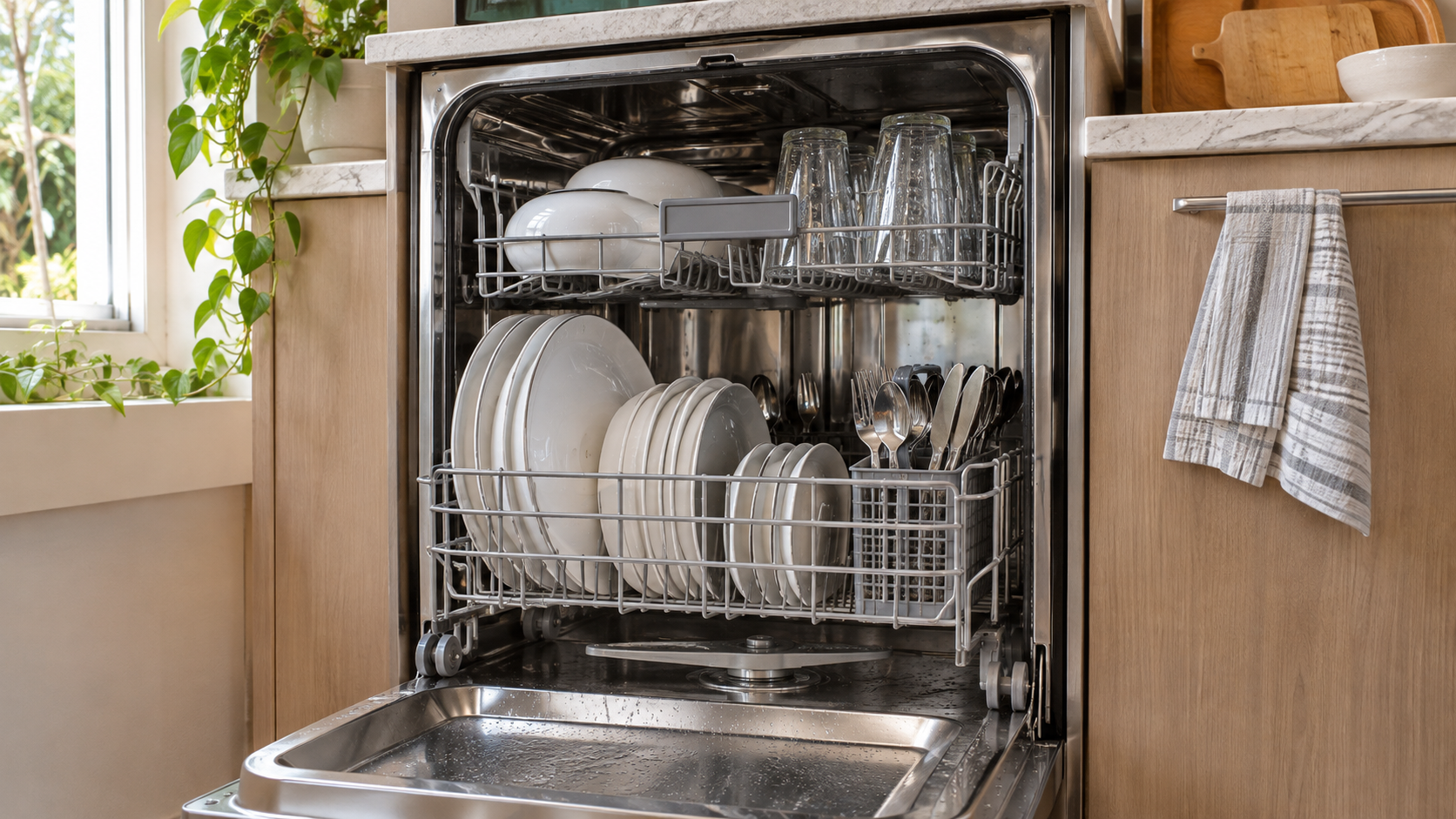
A dishwasher’s racks hold items in the paths of water jets. The machine does not need to submerge the top rack in a cabinet full of water. Water collected low in the appliance supplies the circulation system.
GE’s explanation of one alternating-spray-arm system describes a fill level below the fine filter cap. That is a particular design, not a fill-height instruction for every dishwasher. Its value here is to show that a relatively small collection area can feed a much larger spray space.
Picture a watering can directed at a shelf of plant pots. The source of the water can be below the highest target because the flow is driven upward. A dishwasher adds a pump and a planned spray pattern; the analogy simply separates the location of stored water from the surfaces it can reach.
Sources: [1]
The pump and spray system deliver the mechanical action
The circulation pump drives liquid toward spray arms and other jets. Water striking a surface helps loosen and move soil. A rotating arm changes where its jets point, giving the spray access to more of the load over time.
Not every arm has to operate simultaneously. In the GE system described here, the wash pump alternates supply between lower and upper spray regions. Pauses and changes in sound can therefore be part of the intended programme, rather than evidence that the whole machine has stopped working.
The distinction matters when reading a general explanation. A diagram showing one continuous loop is a conceptual map. It does not establish the valve sequence, number of pumps, arm timing or jet arrangement in a specific model.
Detergent, temperature and spray access work together
A GE user guide describes the cleaning action as spraying a mixture of hot water and detergent against soiled surfaces. The fluid must reach the surface for that action to be useful. The chemistry that helps remove grease is only part of the job: adding a cleaning agent cannot compensate for every physical obstruction.
Consider two bowls nested tightly together. The outside may be exposed to the spray while the covered inner surfaces receive little direct flow. The issue is geometry: the machine cannot direct the same cleaning action through an impermeable bowl wall.
This is why loading belongs in an explanation of the mechanism. It is not merely a way to fit more items in the racks. The arrangement determines which surfaces are exposed, whether an arm can move and whether the dispenser can open as intended. Follow the appliance manual and the item’s dishwasher-suitability instructions.
| Part or idea | What it does | Common misunderstanding |
|---|---|---|
| Circulation pump | Moves liquid through the spray system during a wash stage. | All sprayed water is immediately replaced by new water. |
| Soil-handling system | Separates or manages food debris according to the design. | Every model has the same removable filter. |
| Drain stage | Discharges used liquid before a later stage. | Circulation and draining are the same operation. |
| Drying system | Promotes water removal after rinsing. | Every dishwasher dries with an exposed heater. |
Recirculation is different from never changing the water
During a wash stage, liquid can return to the lower collection area and be pumped through the spray system again. Soil-handling features help manage the material removed from the dishes. Later, draining removes that used liquid and the machine admits water for another stage.
GE’s guide describes separated soil leaving with drained water and clean water replacing it; the number of fills depends on the selected cycle. Its maintenance guidance also tells owners to check whether their particular model has a removable filter, rather than assuming that all machines do.
A useful conceptual distinction is “within a stage” versus “between stages”. Reusing the working liquid within one wash stage is not the same as keeping it through every rinse. Conversely, hearing water circulate does not tell you that the inlet valve is continuously adding fresh water.
The rinse and the drying stage solve different problems
Rinsing exchanges the wash liquid for a later water stage. Drying then addresses the moisture remaining on dishes and inside the cabinet. A clean item can still be wet; cleanliness and dryness are different observations.
Rinse aid changes how water behaves at surfaces. GE describes it as reducing surface tension so that water flows off dishes more readily, improving drying and reducing spotting. It is not a miniature towel, and it is not a replacement for the wash-stage detergent.
Think of a mug with a deep recess facing upward. Even if water drains well from its walls, that recess can still act as a small container. Surface behaviour and item orientation both matter. This is a geometric example, not a diagnosis of a particular wet load.
Sources: [5]
Why some machines dry by condensation
Bosch describes a condensation-drying approach in which the final rinse heats the dishes. Moist air then meets a cooler interior surface, where water condenses into droplets that run down and are drained.
This is a transfer process: liquid on an item can evaporate, while water vapour condenses elsewhere in the cabinet. Seeing droplets on the tub wall therefore does not, on its own, mean the drying mechanism has failed. Bosch’s guidance specifically explains that interior condensation can be expected.
Different appliances may supplement or use other drying arrangements. The key qualification is that a description of one brand’s condensation system is not proof that every dishwasher uses identical hardware. Use the model’s instructions when choosing a programme or interpreting its drying options.
A useful way to interpret the noises
A wash pump, moving water, dispenser opening and draining can produce distinct sounds at different points. GE’s sound guide distinguishes normal circulation sounds and pauses from rhythmic knocking that can occur when an arm hits an item.
The lesson is to connect a sound with an operation, rather than assume that every change is a fault. A model’s documented cycle sequence is more informative than expecting one constant hum from beginning to end.
For ordinary loading, leave the spray paths and dispenser clear as the manual directs. Persistent faults need model-specific guidance. This explanation does not require opening electrical compartments, defeating a door latch or operating the machine with protective parts removed.
Sources: [2]
Questions readers ask
Does a dishwasher fill right to the top?
A typical domestic dishwasher directs jets through the cabinet from a lower water collection area. It is not a sink filled to the height of the upper rack.
Does it reuse dirty water?
It can circulate wash liquid within a stage while managing soil, then drain and replace the liquid for later stages. The exact sequence depends on the selected programme and model.
Why does the spray sound change?
Some systems alternate which spray regions receive water. The programme can also pause, fill, heat or drain. A changing sound alone is not a diagnosis.
Is rinse aid the detergent?
No. Rinse aid is used to improve water runoff and drying behaviour. Use the products and dispenser settings specified for the appliance.
Do all dishwashers have the same filter?
No. Manufacturer guidance distinguishes models with removable filters from other soil-handling designs. Check the manual before following a cleaning procedure.
Cleaning depends on a route through the load
A dishwasher coordinates flow, chemistry, heat, time and drainage. Its racks and spray paths are part of that coordination, because each item has to be exposed to the working liquid and then able to shed it.
Following the water makes the hidden cycle easier to understand: collect it, drive it through jets, manage the soil, drain it, rinse and remove the remaining moisture. The sequence is shared at a broad level even when individual machines implement it differently.
Continue exploring
Sources and further reading
- GE Appliances — Circulation System with Alternating Spray Arms
- GE Appliances — Normal and Abnormal Dishwasher Noises
- GE Appliances Canada — Dishwasher user guide: How your dishwasher cleans
- GE Appliances — How to Clean Your Dishwasher
- GE Appliances — Using the Rinse Aid Dispenser
- Bosch — Tips to Maximize Drying
- Bosch — Water in the Tub and Condensation
Keep exploring.
One remarkable idea at a time—nature, science, history and beyond.
Last updated November 6, 2026.

Barnakle Editorial Team
Barnakle Editorial Team is the collective byline used for Barnakle’s editorial articles. The contributor profile explains the team identity and links to the publication’s editorial policies.
More from the editorial team →