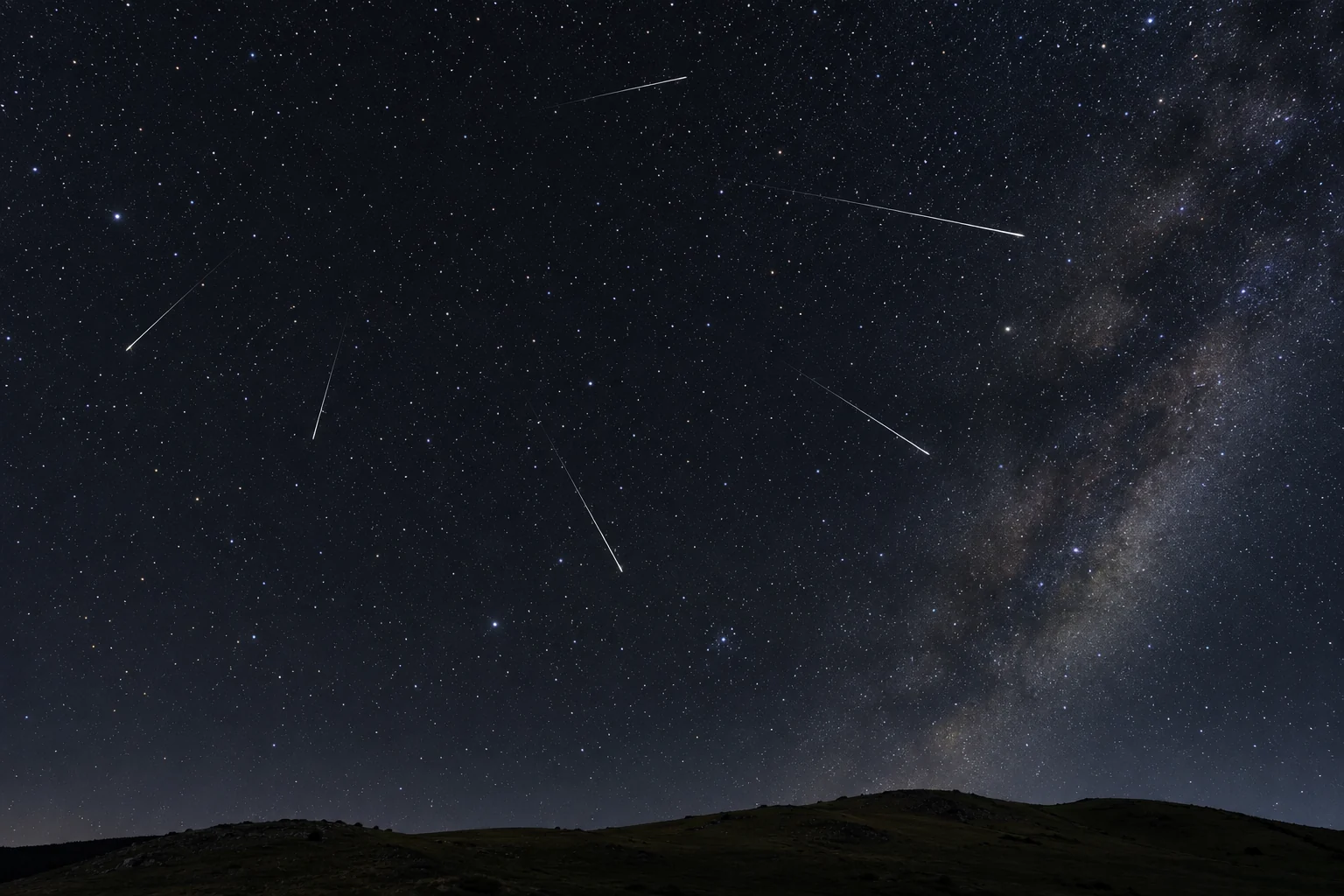
A bright streak runs east across one part of the sky. A second shoots south, and a third appears to drop straight toward the horizon. They could all belong to the same meteor shower. Trace each streak backwards along the sky and the three paths may converge in a small patch of stars. Astronomers call that patch the radiant. It marks the direction from which a stream of particles approaches Earth. The meteors light up in different places in our atmosphere, sometimes many degrees away from the stars that give the shower its name. [1, 2]
One direction, many paths
Imagine standing between two long, straight rows of orchard trees. The spacing between the rows stays the same all the way to the far end. Yet the gap between them occupies less and less of your view as you look into the distance. Extend the rows on a photograph and they appear to meet. Now turn around. The rows also converge in the other direction. To decide which end marks the approach of something travelling along a row, you need to know which way it moved. [1, 2]
A shower offers a moving version of that geometry. A stream of small particles orbits the Sun. When Earth encounters part of the stream, the incoming particles have similar velocities relative to an observer travelling with Earth. Over the short segments that we see glowing in the atmosphere, their paths are approximately parallel. A particle passing to your left can appear to move farther left, while one passing to your right can appear to move farther right. The two pieces of debris have no need to fly apart for you to see their streaks diverge. [1, 2]
Distinguish the particle from the light you follow. A meteoroid is the object in space. A meteor is the luminous atmospheric event. The bright segment begins where the event becomes visible and ends when it fades below visibility. Neither endpoint has to be anywhere near the radiant. The rest of the line that an observer draws back across a star chart is a geometric extension. No particle had to light up that stretch of sky. [1, 2]
What to look for in a pair of streaks
Suppose two meteors appear below the same recognizable group of stars. One moves down and away from the group. The other climbs toward it. On a photograph both streaks might look like little strokes aligned with those stars. If the group contains the shower radiant, the downward-moving meteor is the plausible candidate. The upward-moving one is travelling the wrong way. Watching the sequence matters because an unmarked line by itself gives you two possible directions of travel. [1, 3]
Distance from the radiant also changes the appearance of a trail. Imagine viewing the same short flight first from the side, then almost end-on. From the side you can see more of its length projected across the sky. Almost end-on, a similar flight can register as a short dash. Close to the radiant a fast particle can therefore appear to make surprisingly little sideways progress. You cannot rank the physical speeds of two meteoroids simply by ranking the lengths of their visible streaks. Their distances, viewing angles and visible path lengths all matter. [1, 3]
The distinction helps when planning where to look. Staring straight at the radiant excludes much of the sky where a shower member might draw a long and conspicuous line. An observer looking some distance away can see more of the sideways component. After a streak fades, remember a star near its beginning and another near its end. Those two landmarks preserve more information about the track than remembering only that something flashed in the eastern sky. [1, 3]
Why one good alignment is only a clue
Some meteors seen on a shower night belong to the sporadic background. A sporadic meteor can cross the right patch of sky and even line up with the radiant by chance. Observers studying weak showers pay attention to direction, angular speed and how far the meteor appeared from the suspected radiant. A chart covering a wide field needs a little care too. The extension follows a great circle on the celestial sphere. A straightedge on an arbitrary flat map need not reproduce that arc accurately over a long distance. [1, 3]
A NASA discussion of meteors caught on camera from the International Space Station illustrates the problem. The photographs were taken around the time of the Perseids. Timing made the shower a plausible source, but the camera was looking down toward Earth's atmosphere. An analyst had to consider the station's viewing geometry before assigning the streaks to the shower. An observer beneath the meteors and an astronaut looking down at them can see quite different arrangements in a frame. The name of the night on the calendar settles neither identification. [4]
The radiant has a measurable width
Even careful observers tracing genuine shower members will not obtain one exact intersection. Measurements carry uncertainty and real meteoroids within a stream have slightly different orbits. Researchers using meteor trajectories can estimate how broadly arrival directions are distributed around a shower's central radiant. One study reported median offsets of about 0.32 degrees for the eta Aquariids and 1.41 degrees for the Southern Taurids in its sample. A single dot on a printed chart can thus represent a tighter grouping for one shower and a looser grouping for another. [5]
Spread on a given date is different from a gradual shift of the centre over several dates. As Earth moves along its orbit it encounters the stream under changing geometry. Shower guides can list a radiant for the date of the peak and describe its daily drift. When comparing observations from different nights, using the appropriate radiant for each date prevents that systematic movement from being mistaken for extra scatter among the particles. [1, 3, 5]
Next time you spot a shower meteor, try locating two places after it fades. One is the patch of sky where you actually saw the light. The other is the patch you reach by extending its path backwards through the stars. The first marks a brief event you witnessed in the atmosphere. The second tells you how Earth was meeting a stream of material in its orbit around the Sun. One short streak can carry both pieces of information. [1, 2]
Related reading
Sources
- American Meteor Society — Meteor shower FAQ
- Swinburne University of Technology — Radiant
- International Meteor Organization — Observing minor showers
- NASA — Perseids or sporadic meteors?
- Monthly Notices of the Royal Astronomical Society — Meteor shower radiant dispersions
Keep exploring.
We’ll email you when the first edition is ready.
Last updated November 27, 2026.

Barnakle Editorial Team
Barnakle Editorial Team is the collective byline used for Barnakle’s editorial articles. The contributor profile explains the team identity and links to the publication’s editorial policies.
More from the editorial team →