Woody scales turn moisture changes into movement
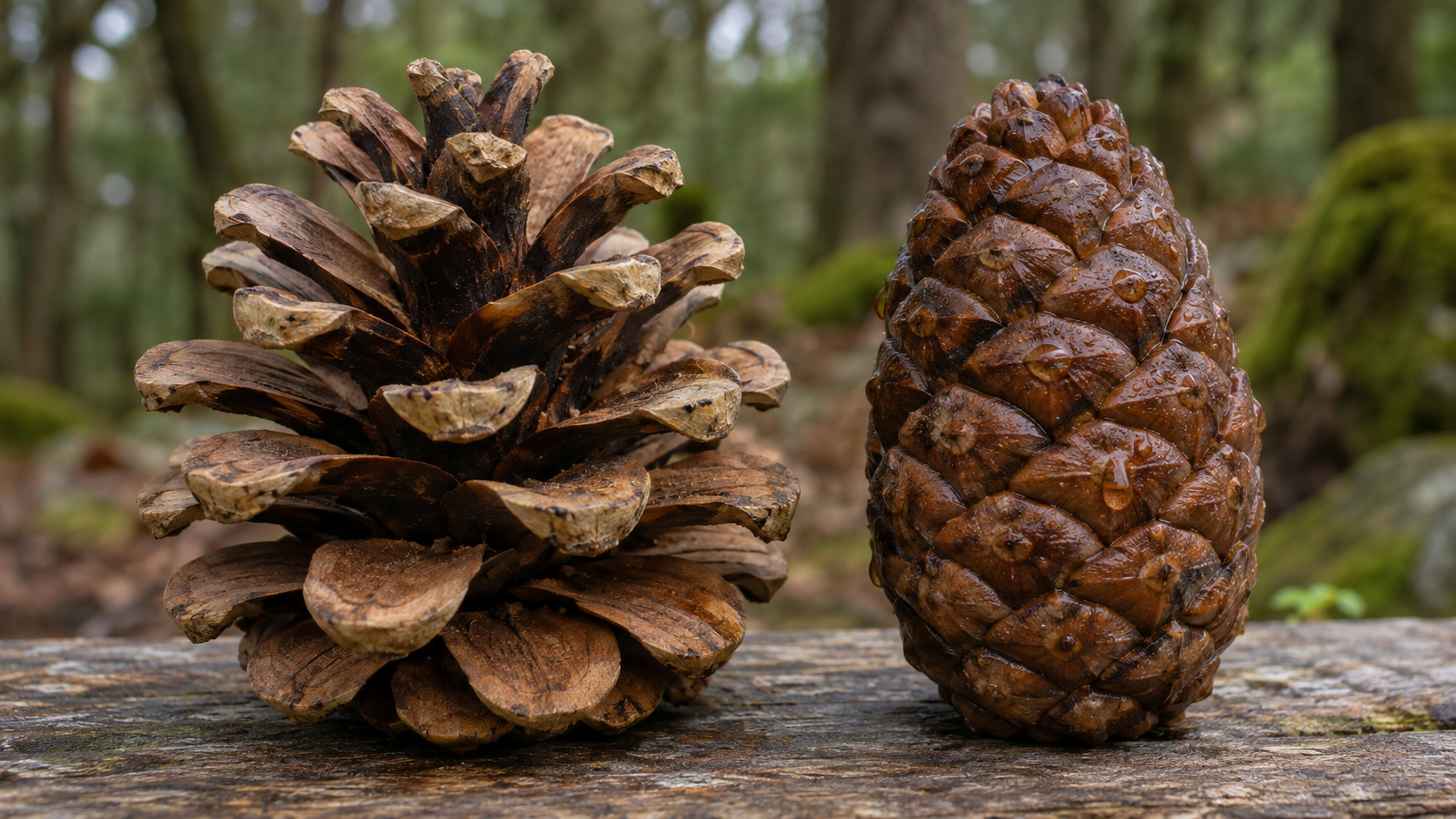
A pine cone on a windowsill can appear to change its mind. One day its scales are spread apart; after damp weather or a spell in water, they can press together again. Nothing obvious is pulling on them, and a cone that has been on the ground for months may still move.
The explanation sits in the material itself. A mature cone is a structure that changes shape as it exchanges water with its surroundings. To understand it, follow one scale before imagining the movement of the complete cone.
Follow the mechanism
- Moisture conditions change around a mature cone.
- Scale tissues take up or lose water at different rates and by different amounts.
- Their connected structure converts those changes into bending.
- Many scales together narrow or widen the gaps around the seeds.
A mature scale can move without being alive
The classic 1997 paper “How pine cones open” identified the essential surprise: cells in the mature cone are dead, yet the structure responds to relative humidity. The movement does not require a living muscle or a fresh growth response each time it occurs.
This is a different kind of plant movement from a shoot gradually growing toward light. The cone’s existing material changes dimensions when its moisture state changes. This differs from the active physiology involved in a living tree moving water. Its cellular architecture still matters even though active metabolism is not driving each opening and closing cycle.
Think of a wooden door that fits differently in a damp season. No living cells inside the door are deciding to swell. The comparison is incomplete, but it establishes the right category of explanation: dead biological material can remain mechanically responsive to its environment.
Sources: [1]
The scale bends because its parts respond differently
A scale contains tissues with different structures and mechanical responses. If connected regions would expand or contract differently when free, their connection constrains that change. Bending is one way the complete structure accommodates the mismatch.
The 2009 study “Hygromorphs: from pine cones to biomimetic bilayers” used a layered-material model to explain this principle. The word hygromorph describes a structure whose shape responds to moisture. The important ingredient is a coordinated difference between parts, rather than simply making the whole object larger.
Imagine two strips bonded together. If one wants to lengthen more than the other, both cannot remain straight and keep their original shared alignment. A curve allows their lengths to differ. That thought experiment explains the principle; an actual cone scale has more complicated geometry than two uniform strips.
Sources: [2]
Water uptake is part of the mechanism, not just a surface coating
Research on water transport in pine cones has examined how water enters and travels within the scale. Moisture reaching the responsive tissues changes their mechanical state; a shiny drop on the outside is not the complete process.
That distinction helps explain why a cone does not necessarily close instantly when touched by one droplet. Water must interact with the material, and the response depends on where it enters and how it moves. A photograph can show wetness without showing the internal moisture distribution.
The 2022 work on passive-hydraulic cone actuation investigated tissue hydration and mechanical behaviour in more detail. Its results support treating a scale as an organised material system, rather than a simple wooden flap on a hinge.
| Part or idea | What it does | Common misunderstanding |
|---|---|---|
| Moisture state | Water is exchanged with the scale tissues. | A cone must be alive to respond. |
| Tissue dimensions | Different regions respond differently. | Every part swells equally in every direction. |
| Scale curvature | The connected structure bends. | A muscle pulls the scale shut. |
| Whole-cone opening | Many scale movements alter the gaps. | Every species follows an identical schedule. |
Why opening during dry conditions can help seeds travel
Opening the scales creates space for seeds to leave. In the familiar humidity-responsive pattern, drier conditions favour opening and wetter conditions favour closure. The relationship connects a material response with the cone’s role in reproduction.
For wind-dispersed seeds, releasing into damp conditions is not equivalent to releasing into dry air. Research on cone movement discusses the protection and timing of seed release in this context. This does not mean that every opening guarantees successful dispersal or germination.
It helps to separate access from outcome. An open gate allows something to pass; it does not ensure that the thing passes immediately or arrives somewhere suitable. A cone’s geometry can regulate an opportunity for seed release while wind, seed condition and the surrounding habitat determine what happens next.
A whole cone is more complicated than one isolated scale
A complete cone has overlapping scales attached at different positions. Their contact and exposure affect how the assembly moves. Isolating one scale is useful for studying its material response, but it removes those relationships.
A 2024 study examined opening and closing sequences in Scots pine cones and investigated which surfaces contribute to water exchange. Manipulating selected regions changed the timing of the movement. The work shows why a single “two layers bend” sketch is an introduction rather than a complete prediction of a cone’s behaviour.
This distinction appears throughout biomechanics. A component has properties; an assembly also has geometry and interactions. Understanding one helps explain the other, but a measured response from a detached part should not be treated as a universal timetable for an intact structure.
Sources: [5]
Why your cone may respond slowly or incompletely
Size, tissue structure, prior condition and the surrounding moisture conditions can affect what you observe. The hygromorph study investigated how movement times relate to scale size and structure. There is no single household countdown that every cone must obey.
A damaged scale or an old cone held partly open by debris may not follow the neatest classroom example. Equally, a cone that changes slowly is not proof that the underlying principle is wrong. It may simply be exchanging water under different conditions from those used in an experiment.
The useful observation is the change in the same specimen over time. Comparing one naturally open cone with another closed cone introduces additional differences, including their species and history. A pair makes an attractive illustration, but it is not, by itself, a controlled before-and-after test.
Watch the response without heating the cone
If you already have a fallen cone you are allowed to keep, photograph it in its starting condition. Observe how it changes after exposure to room-temperature water and then during ordinary air drying. Keep the viewpoint and a nearby size reference consistent.
Record the times and conditions instead of expecting an immediate result. Looking at a sequence can reveal which scales move first and whether the gaps change evenly. Do not use an oven, flame or other heating shortcut for this observation; that introduces a different condition and is unnecessary for watching moisture response.
The exercise demonstrates behaviour in one specimen. It does not measure an exact humidity threshold or establish that all pine cones respond the same way. A calibrated humidity measurement and a defined sample would be needed for a more quantitative claim.
Questions readers ask
Are pine cones alive when they open and close?
Mature woody scales can perform this movement after their cells have died. Their material structure remains responsive to moisture.
Why do they close in water?
Water uptake changes the dimensions and mechanical behaviour of connected tissues differently, bending the scales toward the closed arrangement in the common moisture-responsive pattern.
Do cones open because they are warm?
Temperature can affect drying conditions, but humidity-responsive opening is explained by moisture exchange and scale mechanics. A warm setting and a dry setting are not identical experimental variables.
Can the same cone close more than once?
Repeated wetting and drying can produce repeated movements in a suitable intact specimen. The structure still has limits and can be altered by damage or deterioration.
Does an open cone still contain seeds?
Not necessarily. Opening can allow seed release, but the visible shape alone does not establish whether seeds remain inside.
The useful machine is already built into the material
The cone’s response shows how shape change can emerge from structure and moisture exchange. No motor needs to pull each scale through a prescribed path. The scale’s organisation makes a particular environmental change produce a mechanical result.
The same broad idea inspires moisture-responsive engineered materials. In the cone itself, the result is especially tangible: a small woody object can continue to open and close long after it has left the tree.
Sources: [2]
Continue exploring
Sources and further reading
- Dawson, Vincent and Rocca (1997) — How pine cones open
- Reyssat and Mahadevan (2009) — Hygromorphs: from pine cones to biomimetic bilayers
- Song et al. (2015) — Journey of water in pine cones
- Eger et al. (2022) — The Structural and Mechanical Basis for Passive-Hydraulic Pine Cone Actuation
- Orchestrated Movement Sequences and Shape-Memory-like Effects in Pine Cones (2024)
Keep exploring.
One remarkable idea at a time—nature, science, history and beyond.
Last updated November 6, 2026.

Barnakle Editorial Team
Barnakle Editorial Team is the collective byline used for Barnakle’s editorial articles. The contributor profile explains the team identity and links to the publication’s editorial policies.
More from the editorial team →