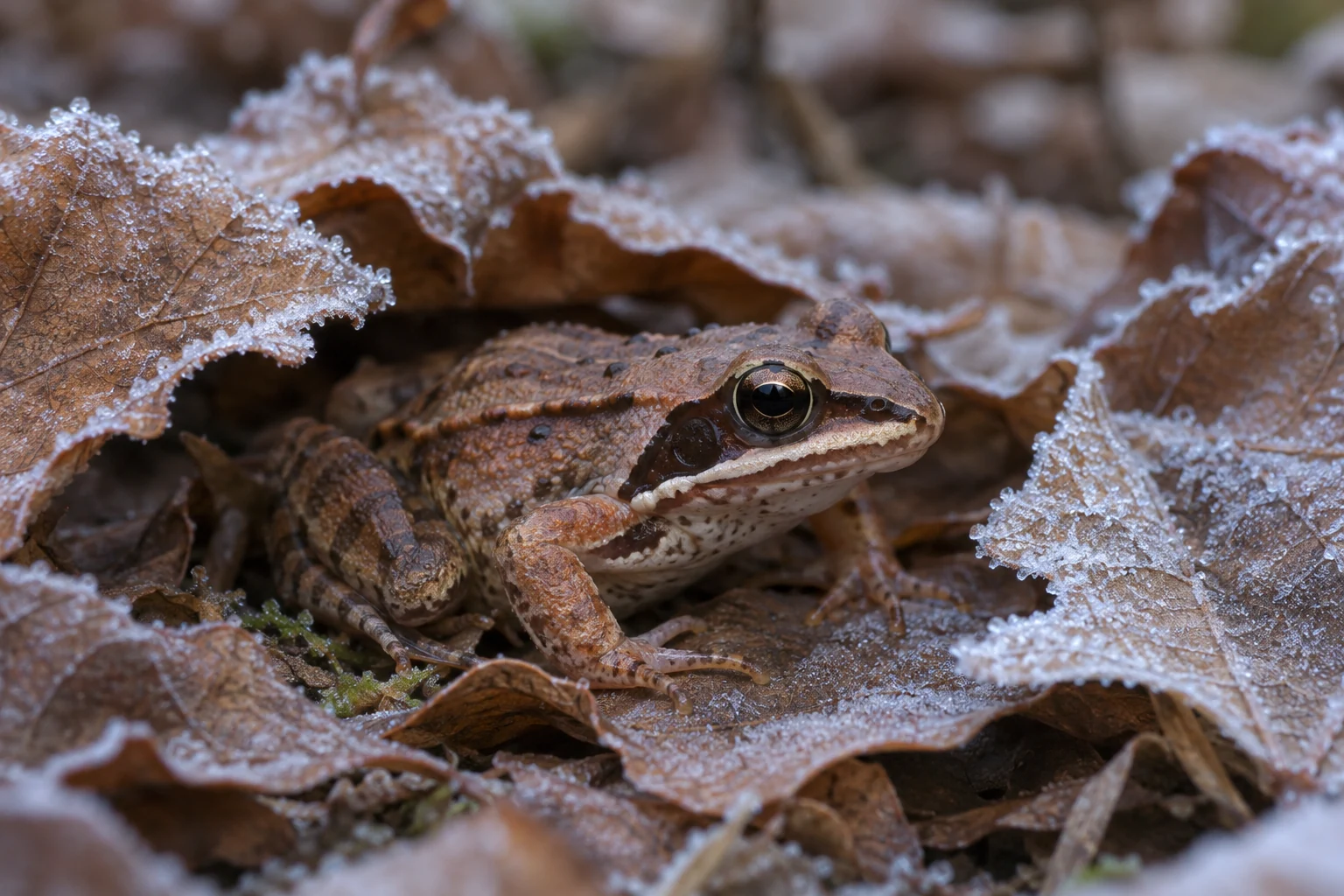
A small forest frog can pass through winter with ice in its body and resume activity when conditions improve. The explanation is a coordinated survival system, not a magical ability to ignore the damage that freezing can cause.
How do wood frogs survive freezing? They tolerate ice outside their cells while protecting the remaining cellular fluid and structures. Cryoprotectants, including glucose, help limit injury, and the animal undergoes major changes in circulation, water balance and metabolism. Survival has limits that depend on the population, season and freezing conditions. [1]
“Frozen” does not mean every cell becomes ice
The distinction between ice outside cells and ice inside them is fundamental. The National Park Service’s Gates of the Arctic explanation describes wood frogs allowing ice to form around cells while protecting their interiors from freezing. A frog can therefore contain substantial ice without every drop of its internal water becoming a crystal. [1]
Ice formation also changes the distribution of water and dissolved substances. Water drawn toward extracellular ice can leave cells dehydrated and concentrated. Surviving winter requires managing those stresses as well as avoiding destructive intracellular ice. The word “frozen” compresses a complicated state into one familiar label.
This is why an image of a frog sealed inside a perfectly solid ice cube is a poor explanation of its physiology. It suggests an undifferentiated block, hiding the very distinction that helps make survival possible.
The liver supplies an important protective sugar
Wood frogs store glycogen, a form of carbohydrate reserve. When freezing begins, the liver can mobilize that reserve into glucose. The sugar is distributed through the body and contributes to cryoprotection. Denali National Park’s account describes this response and the protection it provides against freezing and dehydration injury. [2]
The important point is a regulated response in a living animal. Glucose is not an external coating around the frog, and protection does not depend on making the entire body incapable of forming any ice. The animal tolerates one kind of freezing while limiting damage to sensitive structures.
“Natural antifreeze” is a memorable phrase, but it can conceal that distinction. A cryoprotectant helps the organism survive the freezing process. It does not necessarily prevent all body water from freezing, and it is only one component of the survival system.
Seasonal preparation changes the outcome
Freeze tolerance is not equally strong at every time of year. Costanzo and colleagues compared winter and spring wood frogs from Interior Alaska. Winter animals had a much greater capacity to survive experimental freezing, alongside larger glycogen reserves and higher levels of protective solutes such as urea.
In that study, winter frogs survived temperatures at least as low as −16°C, while the lower survival limit for spring frogs lay between −2.5°C and −5°C. Those are results from defined experimental groups, not a universal temperature rating for the species. They show why season must be part of the explanation. [5]
An individual’s species name alone does not describe its current physiological preparation. A number removed from its experimental context can turn a remarkable adaptation into a misleading claim of unlimited resilience.
What researchers found in natural winter shelters
Laboratory results are valuable, but an animal’s actual winter includes fluctuating conditions and a particular shelter. Larson and colleagues tracked free-living wood frogs into natural hibernacula in Interior Alaska, recorded their microclimate and assessed survival in spring.
Their 2014 study reported 18 animals surviving a winter with roughly six months of continuous freezing. Naturally freezing frogs also had higher glucose concentrations in several tissues than comparison animals frozen under the laboratory protocol. The finding connected the natural seasonal experience with a measurable physiological difference. [3]
The shelter matters because the temperature experienced by a frog is the temperature of its immediate environment. A distant weather station’s lowest air reading is not automatically the animal’s body temperature. Tracking both the animal and its surroundings makes the observation much more informative.
Repeated freezing and thawing can affect protection
Early winter need not be one smooth slide from warm conditions to a stable frozen state. A frog may experience several freezing and thawing events. Larson and Barnes investigated this pattern experimentally, asking whether repeated events could help explain the high glucose levels found in naturally frozen Alaskan wood frogs.
Their 2016 study found stepwise increases in tissue glucose over successive events. Short thaws did not produce a statistically significant reduction under the tested conditions, and the resulting levels approached those found in the naturally frozen animals. The authors proposed that this seasonal pattern contributes to enhanced protection. [4]
This does not mean any arbitrary sequence of freezing and warming is beneficial. The result concerns particular animals and protocols. It demonstrates that the history of cooling can matter, rather than establishing a simple rule that more freezing is always better.
How can the animal persist without normal circulation?
During the frozen state, familiar signs of activity can cease. Denali’s account describes the absence of normal breathing and heartbeat, followed by the resumption of activity after thawing. The animal remains viable through a profound change in physiological state. It has not crossed from death back into life. [2]
Storey’s experiments examined metabolism in different organs over repeated freezing and thawing cycles. Glucose accumulated during freezing, and metabolic end products such as lactate and alanine changed during the cycle. The organs also differed in their inferred anaerobic energy requirements. [6]
The finding is important because inactivity is not the same as an absence of every chemical process. A still animal can have reduced, reorganized metabolism. “Paused” is an analogy for its outward appearance, not a literal claim that all molecular activity has stopped.
Thawing is part of the adaptation
Survival is assessed after the frozen interval, when the animal must recover functioning. Storey’s study observed changes during thawing as well as freezing, including the handling of glucose and accumulated metabolic products. The relevant system therefore includes entry into the frozen state, persistence and recovery. [6]
This three-stage view is more useful than focusing only on a minimum temperature. An animal that withstands a cold exposure but cannot recover would not demonstrate the same survival capacity. Researchers need to follow outcomes beyond the most visually dramatic moment.
Wood frogs show how a relatively small animal can survive an environment through coordinated preparation and response. Their achievement is impressive precisely because the stresses are real and the protection has boundaries.
Frequently asked questions
Do wood frogs freeze all the water inside every cell?
No. Protection of the cellular interior, while ice forms outside cells, is a central part of the explanation.
Are they dead while frozen?
No. A surviving frozen frog remains viable despite the suspension of familiar outward functions. Thawing restores activity rather than reversing death.
Can all frogs do this?
No. The article concerns wood frogs and defined freeze-tolerant populations. It should not be generalized to every frog or every winter condition.
Is there one lowest temperature every wood frog survives?
No. Season, population, cooling history and exposure conditions affect the outcome. The seasonal comparison illustrates that variability. [5]
Keep exploring
Sources and further reading
- National Park Service, Gates of the Arctic — Biological miracle and extracellular ice
- National Park Service, Denali — Wood frog winter biology
- Larson and colleagues (2014) — Wood frog adaptations to overwintering in Alaska; research abstract
- Larson and Barnes (2016) — Cryoprotectant production over multiple freeze-thaw cycles; research abstract
- Costanzo and colleagues (2014) — Seasonality of freeze tolerance in a subarctic population
- Storey (1987) — Organ-specific metabolism during freezing and thawing; research abstract
Reference review: November 10, 2026.
Keep exploring.
One remarkable idea at a time—nature, science, history and beyond.
Last updated November 12, 2026.

Barnakle Editorial Team
Barnakle Editorial Team is the collective byline used for Barnakle’s editorial articles. The contributor profile explains the team identity and links to the publication’s editorial policies.
More from the editorial team →