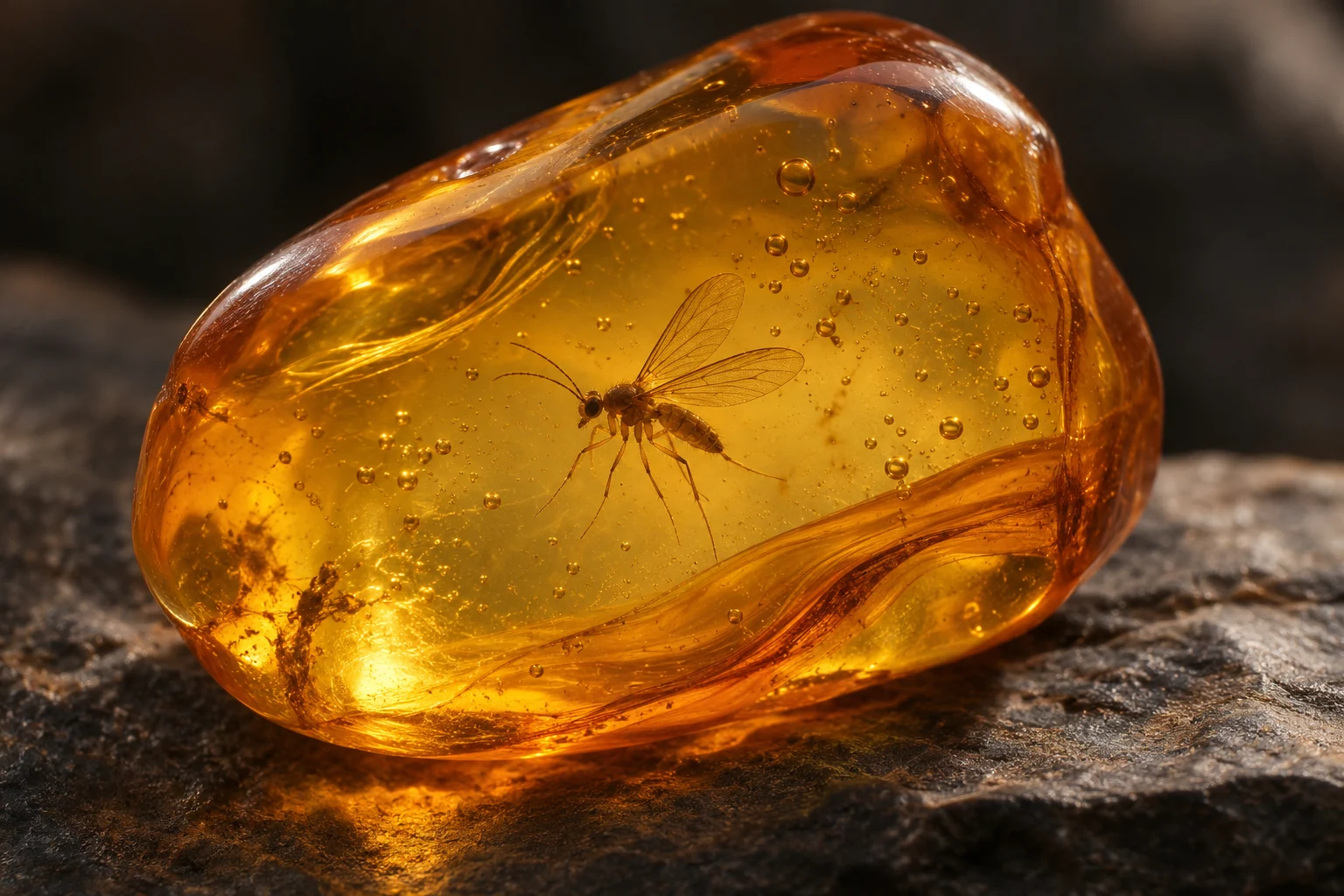
An amber inclusion can preserve delicate legs and wings in remarkable detail. The insect entered a soft, sticky resin long before the surrounding material became the hard fossil resin we call amber.
How do insects become trapped in amber? Fresh tree resin can catch small organisms and later flows can enclose them. If the resin survives burial and the right chemical changes, it can mature into amber. The preserved result may retain striking external detail, but preservation varies and a lifelike outline does not mean every original tissue survives. [1]
The trap begins as resin on a tree
Resin is a sticky plant secretion, not simply another name for every liquid moving inside a tree. Getty’s account describes resin covering damaged bark, forming a protective seal and trapping small material on its way down trunks or branches. Successive flows can create layers and enclose objects already caught. [1]
An insect does not need to fall into a pool of already solid amber. At the moment of capture, the material can be soft enough to contact the body and restrict movement. Enclosure and long-term preservation happen through subsequent stages.
That sequence separates the short biological event from the long geological record. The initial encounter might be brief, but the object eventually studied in a museum has experienced a much longer history.
Burial changes both the resin and its setting
Material can be moved away from the tree before its final burial. Resin-bearing debris may enter sedimentary environments, and later geological processes can redeposit older material. The place where amber is found is consequently not always the exact place where the resin-producing tree stood.
Getty describes the loss of volatile components and the joining of molecules into larger structures during maturation. It also notes that the process is a continuum influenced by composition and geological conditions, rather than a universal clock that converts all resin at one exact age. [1]
The term fossil resin captures the broad transformation. It should not be taken to mean the original insect has necessarily been replaced by one uniform mineral in exactly the way imagined for some other fossils.
What is actually preserved?
The National Park Service distinguishes amber entrapment within a wider discussion of preserved remains. Its account notes that original material can decay within the resin, leaving a mould or other record of its form. Amber preservation does not guarantee an intact body with all internal parts unchanged. [2]
A recognisable outline is nevertheless valuable evidence. Surface features can help identify an organism and compare it with other fossils or living relatives. The important point is to investigate the state of preservation rather than infer it from appearance alone.
The distinction is similar to reading an impression: shape can persist after some of the material that created it has changed or disappeared. A fossil can be informative without being a perfectly sealed, chemically untouched specimen.
Why some resin preserves better than other resin
Researchers have tested preservation using modern insects and different tree resins. A 2018 experimental study found markedly different decay outcomes for fruit flies enclosed in the two resins examined. One retained anatomical features that were lost or poorly preserved in the other. [3]
The study demonstrates that resin type can introduce a preservation bias. It does not establish that one chemical ingredient explains every difference. The authors identified complex interactions between resin chemistry, the organism and decay processes that still needed investigation.
This matters when comparing fossil deposits. A collection with many well-preserved examples may reflect favourable preservation as well as the original abundance of animals. The fossil record is an outcome of both living communities and the processes that preserve them.
How can aquatic organisms end up in tree resin?
Not every trapped organism had to be flying around a high branch. Florida Museum researchers allowed resin to flow into swamp water and observed it trapping small aquatic organisms. Their experiments helped explain how resin associated with trees could preserve inhabitants of a watery environment. [4]
The result broadens the range of possible capture settings. Resin can interact with water, ground litter and other surfaces, so an inclusion’s identity has to be interpreted in context rather than forced into one standard picture of a forest insect.
Experimental analogues are useful because they let researchers observe a process that cannot be replayed in the original ancient forest. They test plausible routes to an outcome without claiming to reproduce every condition of a particular fossil deposit.
Why an amber collection is not a complete census
To become part of the record, an organism must encounter the resin, be enclosed, survive the relevant decay and burial processes, and eventually be found. Each stage can favour some organisms or features over others. Missing from a collection does not automatically mean absent from the original ecosystem.
Preservation experiments make one of those filters visible. The 2018 study’s differences between resins show why biological comparisons need to consider how the fossils were made, not simply count the objects in a drawer. [3]
A careful reconstruction combines the inclusions with sedimentary context, plant evidence and other fossils. The strongest interpretation draws on several kinds of evidence rather than treating amber as a perfect snapshot of everything nearby.
Does the insect still contain ancient DNA?
Visible preservation and molecular preservation are different questions. A 1997 study attempted to reproduce earlier claims of DNA recovery from amber- and copal-preserved insects and failed to detect authentic ancient insect DNA. That challenged the reproducibility of the claims rather than proving that appearance alone could predict genetic survival. [5]
A later study reported DNA recovery from insects in much more recent copal, a less mature resin material. Those samples were only about 60 years old, and the researchers still found substantial degradation. Their result does not demonstrate recoverable genomes in amber millions of years old. [6]
The relevant conclusion is bounded: a convincing anatomical fossil is not evidence by itself for a complete ancient genome. Claims about DNA require their own authentication, controls and age context.
The value of a small, imperfect record
Amber is valuable because it can preserve forms and associations rarely accessible in other settings. Its limitations do not remove that value. They tell researchers which questions can be answered directly and which require additional evidence.
Following the whole sequence—from sticky resin to burial, maturation and discovery—makes an inclusion more informative. The fossil is both a record of an organism and a record of the processes that allowed part of its history to reach us.
Frequently asked questions
Was the insect trapped in hard amber?
No. The initial trap was soft resin. Hardening and longer-term maturation came later.
Is every amber inclusion perfectly preserved?
No. Decay and preservation vary, and a detailed external form does not guarantee unchanged internal tissues.
Can water-dwelling organisms be included?
Yes. Experiments show that resin flowing into water can trap aquatic organisms.
Does a fossil insect’s appearance prove it has usable DNA?
No. Genetic preservation is a separate question that requires direct, authenticated evidence.
Keep exploring
Sources and further reading
- J. Paul Getty Museum — Resin production, burial and amber formation
- National Park Service — Preserved remains and entrapment in amber
- Research paper (2018) — Preservation bias tested through experimental decay
- Florida Museum — Experiments showing aquatic organisms trapped in resin
- Research paper (1997) — Reproducibility of ancient insect DNA claims; abstract
- Research paper (2021) — DNA from recent copal inclusions: limits and perspectives
Reference review: November 11, 2026.
Keep exploring.
One remarkable idea at a time—nature, science, history and beyond.
Last updated November 12, 2026.

Barnakle Editorial Team
Barnakle Editorial Team is the collective byline used for Barnakle’s editorial articles. The contributor profile explains the team identity and links to the publication’s editorial policies.
More from the editorial team →