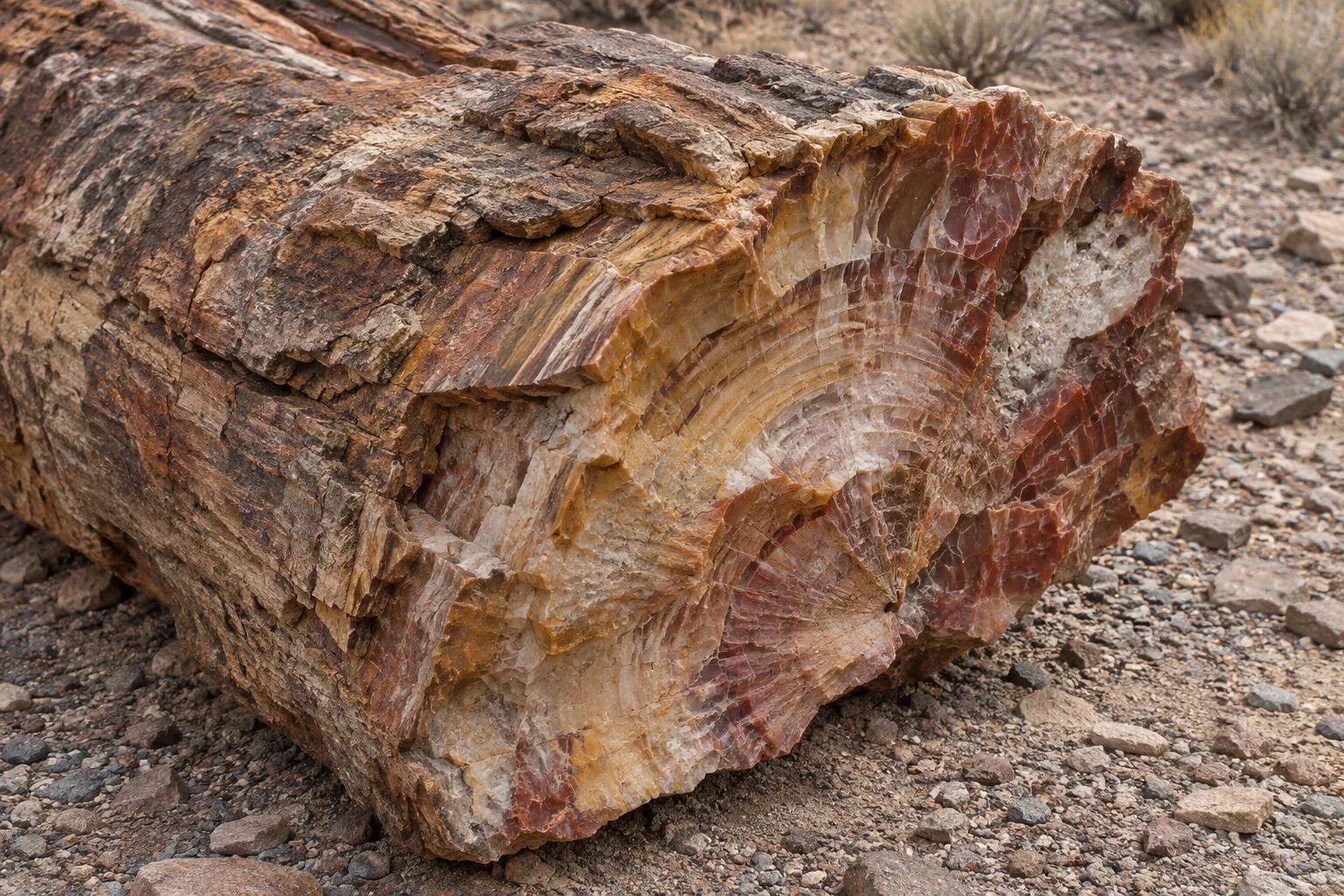
Petrified wood forms when minerals preserve the structure of wood as buried plant material changes and decays. Mineral-bearing water moves through the wood, depositing material in spaces and sometimes replacing the original tissue. Silica is especially common, producing fossils that can retain a tree’s shape, grain and even microscopic anatomy. [1, 2]
The phrase “wood turned to stone” describes the result, but hides the process. A log does not simply become harder because it is old. Its preservation depends on the interaction of organic tissue, water and mineral chemistry.
Why burial matters
A fallen tree exposed at the surface is vulnerable to organisms, weathering and physical breakage. Rapid burial can reduce oxygen availability and slow some forms of decay, giving mineralization an opportunity to preserve structures before they are lost. The buried wood must still interact with suitable water rather than being sealed away from every fluid. [2]
Petrified Forest National Park provides a classic example. More than 200 million years ago, logs entered an ancient river system and were buried in sediment. Silica-bearing water later contributed to their mineralization. The trees belonged to a very different environment from the dry landscape in which many fossil trunks are visible today. [2]
Burial is helpful, but not sufficient by itself. A buried branch in ordinary soil need not become a detailed stone fossil. The chemical environment and the relative rates of mineral deposition and tissue destruction also have to be favorable.
How groundwater carries the building material
Water can transport dissolved substances through sediment and porous wood. Under suitable conditions, those substances precipitate as minerals. Silica may come from the weathering of silicate materials, including volcanic ash. It reaches the wood in solution rather than as grains of sand that must be forced into every cell. [1]
Wood already contains a complex architecture of cell walls and open spaces. That architecture helps determine where fluids can move and where minerals can accumulate. Preserving its pattern therefore does not require a mineral to grow into the shape of a tree independently: an existing biological structure provides the starting template.
The process can continue through more than one episode of water movement. A fossil may record a changing chemical environment, with different materials entering at different stages rather than one uniform mineral bath finishing the entire trunk at once. [3]
Permineralization and replacement are different ideas
Permineralization means minerals fill pores and spaces within original material. Replacement means minerals take the place of original material as that material is lost. Both can preserve aspects of the original structure, and they may occur together. [1]
The distinction is especially useful for wood. A recognizable cell outline does not prove that its original organic wall is still present. The outline may instead be preserved in mineral. Chemical and microscopic observations are needed to distinguish anatomical preservation from the survival of the actual tissue.
A 2017 investigation used microscopy and thermal analysis to examine these relationships. It argued that mineralization and degradation commonly overlap, so many specimens cannot be described accurately by choosing only one of two completely separate pathways. Preservation depends on how those processes proceed relative to one another. [5]
Why a detailed fossil may contain little wood
Pattern and material are separate kinds of information. A cast can reproduce a shape while being made of something different from the original object. In petrified wood, mineralization can preserve fine anatomical relationships even after much of the original organic matter has disappeared. [5]
Think of a hypothetical building whose rooms and corridors are mapped before its original walls are progressively replaced. The surviving arrangement could preserve useful information about the old building even if its materials were largely new. The analogy illustrates preservation of relationships; it does not imply that petrification follows a neat room-by-room construction schedule.
Some specimens do retain organic material, while others are extensively mineralized. Visible grain alone cannot quantify that amount. A polished surface may be beautiful and informative without answering every question about the chemistry of preservation.
Does every piece follow the same mineral sequence?
No. A study of Nevada fossil wood from 21 localities found evidence for multiple silicification pathways. Mineralization could vary between specimens from the same layer and within an individual specimen. The work distinguished early changes involving cell walls from later deposition in open spaces such as cell interiors, vessels and decay cavities. [3]
Opal, chalcedony and quartz can occur in different combinations. Some mineral forms may precipitate during separate episodes; others can reflect later transformations. Treating every piece as having passed through one mandatory sequence would erase that variation. [3, 7]
The broader lesson is that “petrified wood” names an outcome shared by specimens with different histories. A useful explanation needs a common mechanism without pretending that every fossil has the same microscopic story.
Where do the colors come from?
Pure quartz is colorless, but fossil wood can contain other minerals, trace constituents and residual organic matter. These influence the colors and patterns. Mustoe and Acosta’s study of petrified-wood coloration examines both mineral chemistry and differences in how coloring materials are distributed. [4]
Iron-bearing materials can contribute red, yellow and brown tones; other constituents and physical structures can produce additional appearances. A simple color chart is only a starting point. The same broad hue does not uniquely identify a chemical composition, and a decorative photograph is not a mineral analysis. [4]
Bands and patches may also cross or emphasize the original wood structure. To read them properly, a geologist must distinguish the tree’s anatomy from features formed during mineralization and later alteration. A vivid stripe is not automatically an annual growth ring.
How long does petrification take?
There is no single universal duration. The age of a fossil deposit and the time required for particular mineralization stages are different quantities. A tree preserved in a very old rock layer did not necessarily need that layer’s entire age to acquire its minerals. [6, 7]
Research in silica-rich hot-spring water documented mineral deposition in modern wood, and experiments placed fresh wood in that environment to observe silicification over years. Such findings demonstrate that significant early mineralization can occur relatively quickly under suitable conditions. They do not show that every ancient trunk became a fully mineralized quartz log on the same schedule. [6]
Water chemistry, temperature, access to fluid, tissue condition and later geological changes all affect what is preserved. The 2023 synthesis emphasizes that simple assumptions based on one modern setting do not reliably explain all fossil localities. [7]
Why do some fossil logs look neatly cut?
Mineralized wood can be hard and brittle. Stress can fracture it into segments whose clean-looking ends resemble cuts. Petrified Forest National Park describes this cracking as a geological consequence of stress rather than evidence of someone sawing up the ancient trees. [2]
Fractures can also cut across growth patterns, revealing the distinction between the tree’s original organization and the later behavior of its mineralized remains. Another example of orderly-looking fractures appears in why some rocks form hexagonal columns.
Questions about petrified wood
Is every plant fossil petrified?
No. Plant fossils can be preserved in other ways, including impressions or carbon-rich remains. “Fossil” is broader than “turned to stone.” [1]
Is all petrified wood quartz?
No. Silica is common, but mineral composition and silica forms vary, and other minerals can preserve wood. [3, 5, 7]
Does preserved grain prove the original wood is intact?
No. Anatomical detail can survive as a mineral pattern even when little organic tissue remains. [5]
What does water contribute?
It carries dissolved substances to and through the buried structure. For another geological record built by mineral-bearing water, read how stalactites and stalagmites record underground time. Petrified wood preserves a biological pattern through a geological process.
Sources and further reading
Sources checked November 15, 2026. Abstracts and research syntheses are identified below where used; restricted full texts are not represented as fully reviewed.
- National Park Service — Permineralization and Replacement
- Petrified Forest National Park — Petrified Wood
- Mustoe (2015) — Late Tertiary Petrified Wood from Nevada, USA: Evidence of Multiple Silicification Pathways
- Mustoe and Acosta (2016) — Origin of Petrified Wood Color
- Mustoe (2017) — Wood Petrifaction: A New View of Permineralization and Replacement
- Akahane and colleagues (2004) — Rapid wood silicification in hot spring water: an explanation of silicification of wood during the Earth’s history — research abstract
- Mustoe (2023) — Silicification of Wood: An Overview — research synthesis and specimen observations
Keep exploring.
One remarkable idea at a time—nature, science, history and beyond.
Last updated November 16, 2026.

Barnakle Editorial Team
Barnakle Editorial Team is the collective byline used for Barnakle’s editorial articles. The contributor profile explains the team identity and links to the publication’s editorial policies.
More from the editorial team →