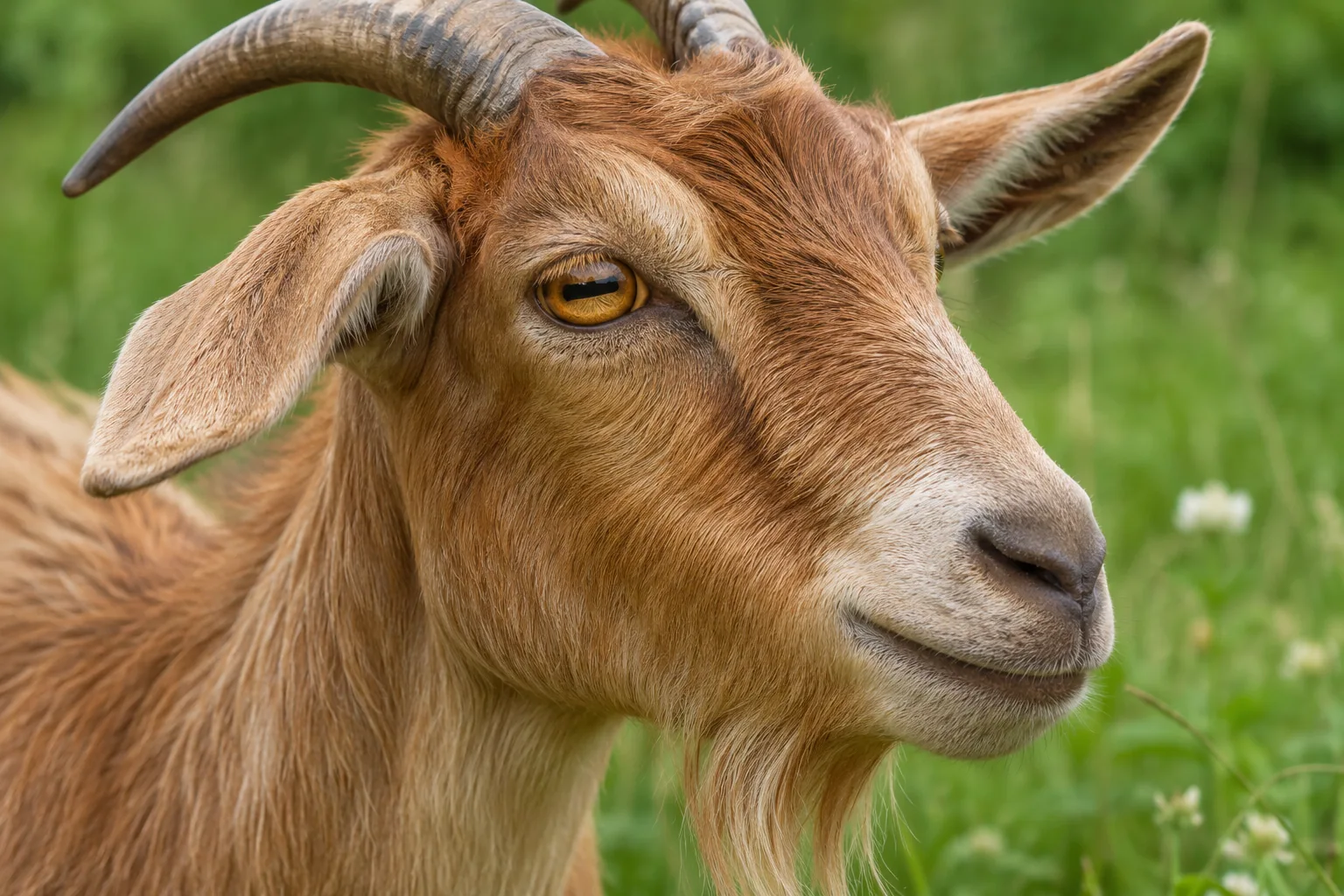
Look closely at a goat’s eye and its dark centre can resemble a rounded rectangle laid on its side. The leading explanation connects that horizontal opening with life as a grazing prey animal: it helps preserve useful views across the ground, where danger may approach from several directions. [1, 2]
The pupil is not working alone. Eye position, the eye’s other optical structures and compensating movements all contribute. Explaining the shape as “goats can see everything” loses the most interesting part of the story: their vision involves particular advantages and trade-offs.
Is a goat’s pupil really rectangular?
“Rectangular” is a useful everyday description, not a claim that the opening has four perfectly straight sides and sharp corners. The comparative research describes these pupils as horizontally elongated and roughly rectangular, with proportions that change as they dilate or constrict. [1]
A separate anatomical investigation described goat pupils as oval in the horizontal plane. Those descriptions need not conflict: a rounded, elongated opening can look more oval or more rectangular under different conditions. A photograph captures one pupil at one moment, rather than a fixed geometric template. [5]
It is also worth separating the pupil from the whole eye. The dark shape is an opening inside the iris. A goat does not have a rectangular eyeball; the anatomical study described the eyeball as almost spherical. [5]
What does a pupil actually do?
The pupil is the aperture through which light enters the eye. The iris controls that opening. The cornea and lens help focus incoming light onto the retina, whose light-sensitive cells convert it into signals that travel toward the brain. The pupil itself is not a screen on which the animal watches the world. [4]
An aperture influences which rays can pass through an optical system. Changing its size affects the amount of light admitted; changing its shape can affect the resulting image in different directions. That is why the orientation of an elongated pupil can matter rather than merely its total area.
The distinction also avoids a common visual misconception. A rectangular entrance does not mean an animal sees a scene surrounded by a crisp rectangular border. Its visual field and the quality of the information within it emerge from the combined system, including where the eyes are directed. [3, 4]
Why are the eyes on the sides of the head important?
Goats’ eyes face outward from the sides of the head. A 2024 review of farmed ungulates describes a broad field available to one eye or the other, with a smaller region of binocular overlap and a rear blind zone. This arrangement is suited to monitoring a wide surrounding area. [3]
Imagine watching for movement while your head is occupied with a patch of food. A system sampling widely around the head can detect an approaching animal without requiring the same constant sequence of turns a narrow forward view would need. This is an explanatory scenario, not a measured account of what a particular goat noticed.
Eye placement and pupil shape should therefore be treated as connected features. Moving a horizontal aperture into a very different eye arrangement would not automatically reproduce a goat’s visual experience. Nor can a number describing field of view tell us how sharply every location within that field is seen.
What did the pupil-shape study find?
In 2015, researchers compared pupil shapes and lifestyles across 214 terrestrial species. Horizontal pupils were strongly associated with plant-eating prey species that had lateral eyes. The authors then used optical modelling to investigate what advantages different apertures could provide. [2]
Their model of a sheep eye suggested that horizontal elongation helps produce useful images of horizontal contours across the surrounding ground. The proposed benefits include detecting approaching predators and guiding movement over uneven terrain. It is a functional explanation supported by modelling and observation, rather than a claim that every detail of goat vision has been measured directly. [1]
That last distinction matters when reading an attractive wildlife fact. A correlation identifies a pattern among animals. A model tests whether a proposed mechanism is plausible. Neither, by itself, recreates the full evolutionary history of a feature or tells us exactly what an animal’s subjective experience is like.
What happens when a goat lowers its head?
If the eyes simply stayed fixed relative to the skull, lowering the nose would change the pupil’s orientation relative to the ground. The research team observed compensating eye rotations in goats and other lateral-eyed grazers. These movements help keep the long axis of the pupil approximately aligned with the ground as the head pitches. [1, 2]
The eyes are rotating within their sockets; the pupil is not a loose component independently swivelling inside the iris. Maintaining approximate alignment preserves the orientation that the optical hypothesis predicts should be useful.
This makes a feeding goat a particularly good reminder that an eye is an active organ. Its orientation changes with behaviour, and a still portrait cannot show the coordination taking place as the head moves.
Do rectangular pupils give goats perfect eyesight?
No pupil shape guarantees perfect focus. A 2023 study used retinoscopy to assess refraction in 28 goats, alongside a donkey group. The goat group was described overall as emmetropic, meaning close to the expected focus without a large average refractive error, but individual eyes still showed variation, including astigmatic refraction. [6]
This study addressed focusing properties. It did not test whether rectangular pupils prevent attacks, and it should not be presented as proof of the entire predator-detection explanation. Different experiments answer different questions.
The broader review also identifies gaps in what is known about ungulate visual abilities. A useful adaptation does not remove blind zones, make all distances equally clear or turn every possible feature of the environment into equally useful information. [3]
Why do cats have vertical pupils instead?
The comparative work linked vertical slits particularly with small ambush predators active in both brighter and dimmer conditions. Its authors proposed benefits for judging the distance of nearby prey. Body size matters too: Berkeley’s account notes that large cats such as lions and tigers have round pupils rather than the domestic cat’s vertical slits. [2]
“Predators have vertical pupils; prey have horizontal ones” is therefore too absolute. The result was a pattern in a studied set of terrestrial animals, with ecological and anatomical qualifications. A pupil is a clue to the demands an animal’s visual system faces, not a universal label for its place in a food web.
For a goat, the most useful answer stays grounded in that combined system: a horizontal opening, lateral eyes and coordinated eye movement help support an extensive watch across the ground while the animal feeds.
Keep exploring
Discover other animal adaptations that change how familiar environments are experienced:
Sources and further reading
Goat-eye evidence reviewed November 16, 2026, separating comparative optical models from direct anatomy. The anatomy and refraction studies below are cited from their accessible abstracts.
- Banks et al. (2015) — Why do animal eyes have pupils of different shapes? Science Advances; author PDF
- UC Berkeley — Pupil shape linked to animals’ place in ecological web; research-team explanation
- The role of light and vision in farmed ungulates and implications for their welfare (2024), Frontiers in Animal Science; review
- National Eye Institute — How the Eyes Work; pupil, iris, lens and retina
- Rajathi — Morphological and Morphometrical Studies of Eyeball and Retina in Goats; abstract
- Pe’er et al. (2023) — A retinoscopic survey of donkeys and goats; PubMed abstract
Keep exploring.
One remarkable idea at a time—nature, science, history and beyond.
Last updated November 16, 2026.

Barnakle Editorial Team
Barnakle Editorial Team is the collective byline used for Barnakle’s editorial articles. The contributor profile explains the team identity and links to the publication’s editorial policies.
More from the editorial team →