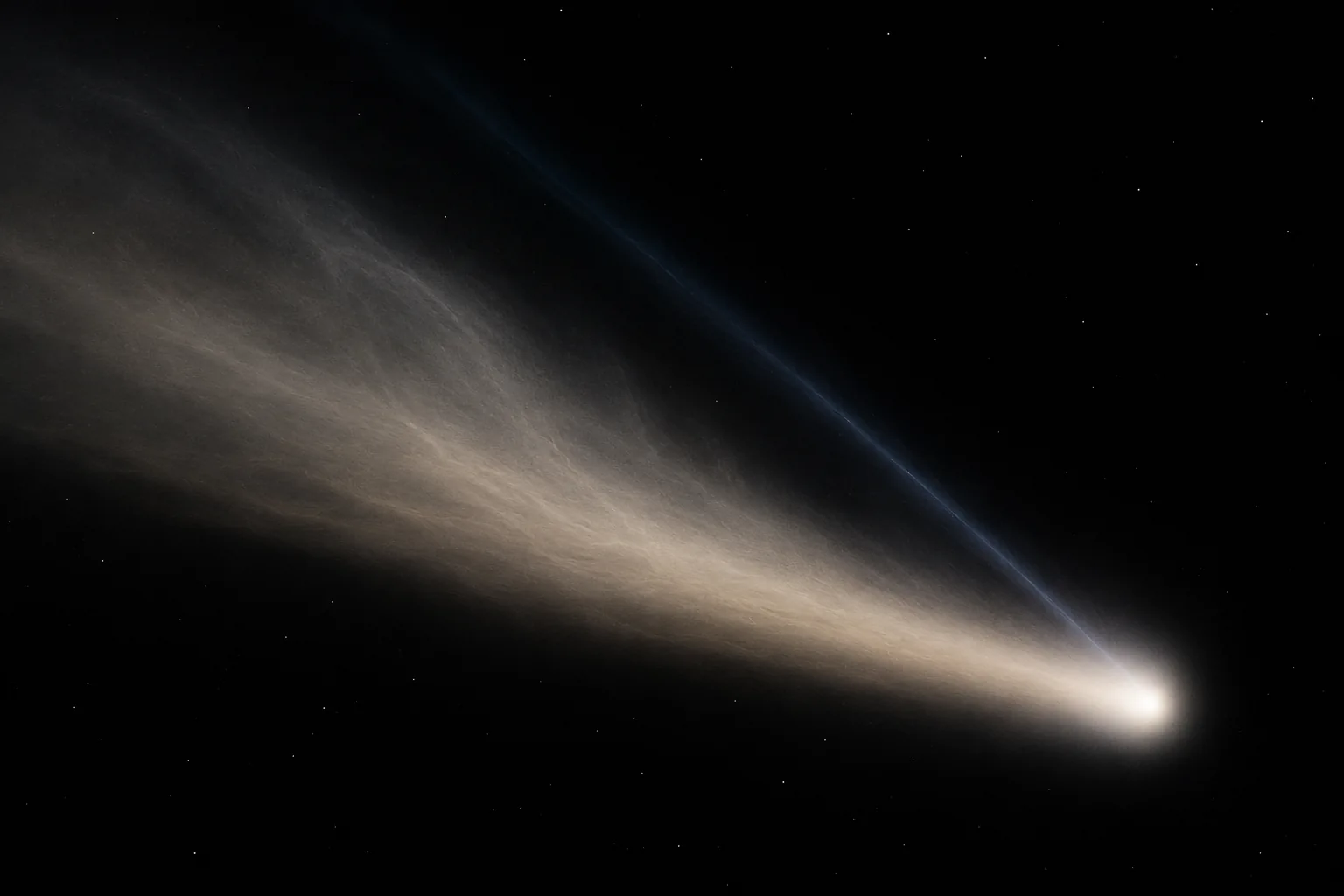
If you want to know which way the Sun lies in a comet photograph, look first for a thin, straight tail. It usually points almost directly away from the Sun. A second, broader tail often curves off to one side. Both come from material released by the same small body, but two different things arriving from the Sun shape them. Sunlight pushes on dust grains. The solar wind carries off electrically charged gas. That distinction explains why the tails can separate and why neither is a reliable arrow for the direction the comet is travelling. [1, 2]
How a small nucleus supplies so much material
At the centre of an active comet is a solid nucleus containing ices, dust and rock. As the Sun warms exposed or near-surface ice, some of it changes directly from solid to gas. The escaping gas can carry grains away from the surface. Gas and dust spread around the nucleus to make the coma, the hazy head you can often see in photographs. A bright, round head in an image can therefore cover an area much larger than the solid object at its centre. [1]
Think about what a camera records during a long exposure. Grains that left yesterday can be in one part of the field while newer grains are still near the head. Sunlight scattered toward the camera makes those many separate particles visible together. An extensive tail does not require a solid strand joining the material to the nucleus. Its continuity in a photograph can come from a continuing supply of particles moving through neighbouring paths. [1, 2]
Why the dust tail bends
A grain that escapes still has much of the comet’s orbital motion. It also feels the Sun’s gravity. Sunlight adds another influence because light carries momentum and can transfer some of it to the grain. This radiation pressure acts away from the Sun. The grain then follows a somewhat different path around the Sun from the one the nucleus follows. Dust grains of different sizes, leaving at different times, gradually spread out into the broad tail. [1, 2]
A useful mental experiment is to compare two spherical grains made of the same material. A grain twice the diameter presents four times the area to sunlight, but has eight times the mass. If the two interact similarly with light per unit area, the larger one experiences only about half the acceleration from that pressure. Real grains differ in shape and optical properties, too. The simple example shows why one release of dust can fan out rather than travel as a single compact cloud.
Now imagine marking the comet’s position every day along its curved orbit. Draw a small arrow away from the Sun at each mark. The arrows change direction as the comet moves, and the particles released at the different marks have different orbital histories. A photograph today superimposes their present positions. The curve you see in the dust is the combined result, so extending the end of that curve backward across a star chart would be a poor way to predict where the comet was last night. [2]
What makes the straighter tail different
Some gas molecules in the coma lose electrons and become ions. Those charged particles interact with the solar wind and its magnetic field. The stream of charged material from the Sun sweeps cometary ions away, forming what astronomers call the ion or plasma tail. The plasma tail often looks comparatively straight and narrow. Some common cometary ions emit blue light, which can help distinguish this tail from the broader dust tail shining mainly by reflected sunlight. Colour alone is an uncertain guide in a processed image. [1, 2]
Changes in the wind can leave a visible break. In 2007 NASA’s STEREO spacecraft recorded a solar eruption sweeping past Comet Encke. The sequence shows part of its plasma tail disconnecting and moving away. A still frame of the detached piece might suggest a permanent injury to the comet. Watching the sequence makes the physical situation clearer. The passing disturbance changed the material well outside the nucleus, while the comet could continue supplying fresh gas. [3]
Can a tail go ahead of the comet?
Take a comet moving away from the Sun after it has passed the closest point in its orbit. It is heading outward, and its ion tail still points generally outward. The tail can now extend ahead of the nucleus in the outward direction. Before the close passage, that same solar influence acted while the comet was coming inward. A tail tied to the solar wind can thus give an entirely different impression of trailing or leading depending on where the nucleus is in its orbit. [1, 2]
There is an even stranger sight known as an antitail. From certain viewpoints a narrow feature can appear to point toward the Sun. Dust spread along the comet’s orbital plane can look especially concentrated when Earth views that plane nearly edge-on. In January 2023, observations of Comet ZTF near an orbital-plane crossing showed just such an apparent spike. The alignment placed dust along the same line of sight. The image did not require sunlight to start pushing those particles back toward its source. [4]
Read a photograph in three passes
First find the head, where the material originates. Next look for a narrow feature extending approximately along the Sun–comet line and a diffuse fan bending away from it. Finally, check where Earth was viewing the orbit from and whether the image combines several exposures. If the two tails overlap in projection, a perfectly active comet may appear to have just one tail. A short exposure might also record only the brighter of the two. [1, 2, 4]
There is one question the photograph alone may leave unanswered. To work out which way the nucleus is actually moving against the stars, compare its position in images taken at known times. The tail gives you evidence about sunlight, the solar wind and material leaving the nucleus. The changing position of the head gives you the comet’s motion across your sky.
Keep exploring
See what light pressure can do to a solar sail and how a disturbance in the solar wind affects technology near Earth.
Sources and further reading
The comet overviews explain the two tails. The Encke and ZTF observations show how a changing solar wind and a changing viewing angle affect individual comets.
- NASA Solar System Exploration — Comet facts
- Lunar and Planetary Institute — Comets, tails and the solar wind
- NASA Astronomy Picture of the Day — Comet Encke’s tail ripped off
- NASA Astronomy Picture of the Day — Comet ZTF at its orbital-plane crossing
Keep exploring.
One remarkable idea at a time—nature, science, history and beyond.
Last updated November 18, 2026.

Barnakle Editorial Team
Barnakle Editorial Team is the collective byline used for Barnakle’s editorial articles. The contributor profile explains the team identity and links to the publication’s editorial policies.
More from the editorial team →