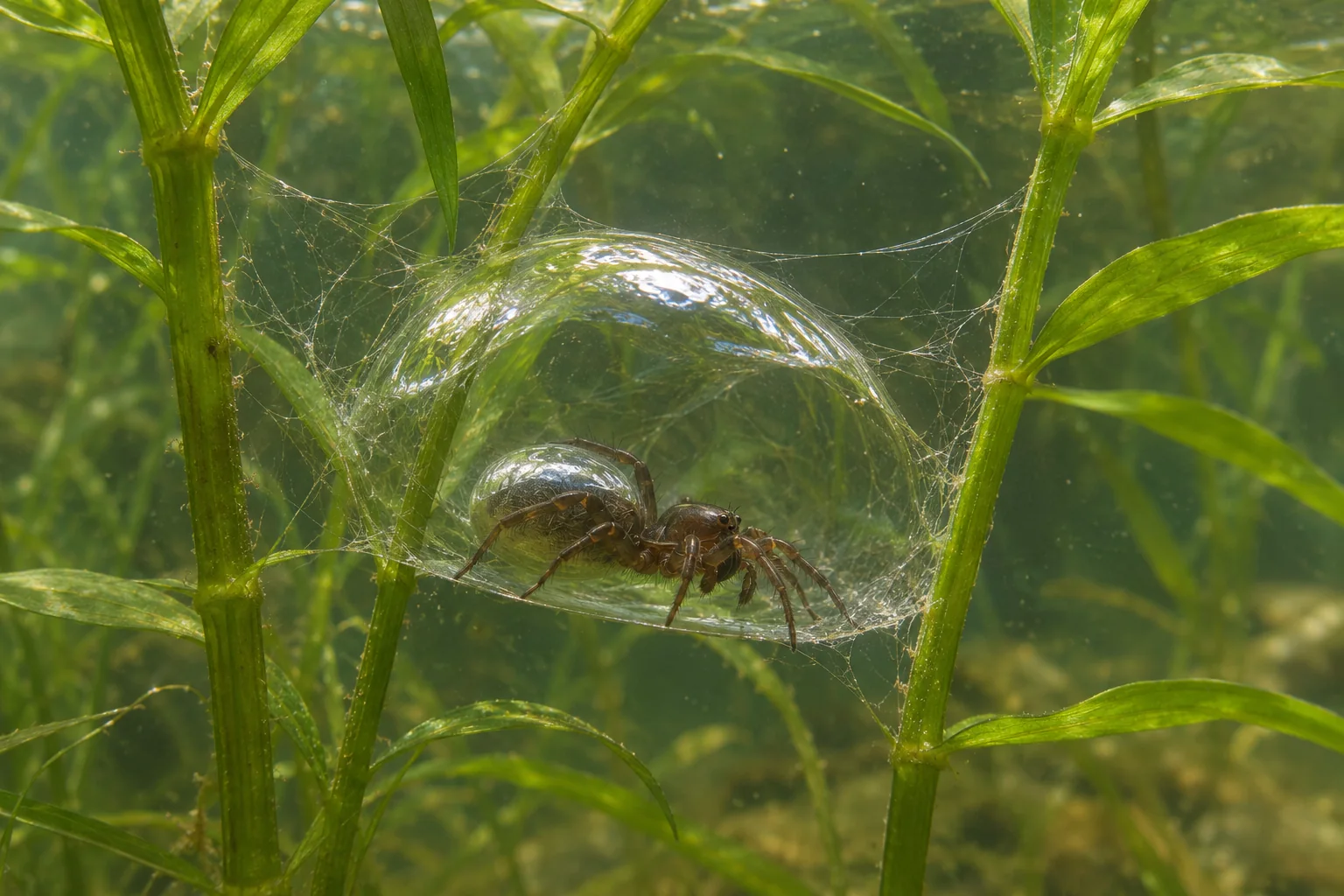
A diving bell spider makes two air pockets worth watching. One travels with the animal, giving its submerged body a silvery sheen. The other stays behind among the pond plants, large enough for the spider to slip inside. Follow a spider back from the surface and you can see how the travelling pocket supplies the stationary one. What you cannot see is that the pond itself helps supply the oxygen.[1, 2]
The Eurasian diving bell spider, Argyroneta aquatica, breathes air. Its trick is to keep a patch of air and water in contact for long enough that oxygen dissolved in the pond can cross into the bell. A fish passes water over gill tissue. This spider builds part of its breathing apparatus outside its body, using silk, bubbles and a convenient pair of underwater stems.[1, 3]
What keeps the bubble from floating away?
Turn a drinking glass upside down and lower it straight into a sink. Water flows around the glass and some enters from below, but a pocket of air stays under the base. Tilt the glass far enough and the air slips past the rim. The glass makes the behaviour easy to see. A spider has a much harder construction job. It starts with an empty patch of water, and its building material comes out as thread.
The spider anchors a silk platform to vegetation. At the surface it lifts the rear of its body into air. Fine water-repelling hairs hold air against it, and its hind legs help it carry a larger load. It takes that load back down and releases it beneath the silk. The bubble rises the last little distance on its own. Successive loads enlarge the pocket, and more silk extends and reinforces the chamber. The entrance faces down, which leaves the owner a way in and gives the buoyant air a roof.[2, 3]
Those journeys explain something odd about the spider’s home. The swimming animal can leave a substantial part of its air supply behind and still come back to it. Imagine trying to hunt with a bubble the size of your living room clinging to your back. Anchoring the largest pocket to a plant gives the spider room to move and leaves a sizable surface available for gas exchange.[1, 4]
Oxygen can cross an apparently still boundary
A pond with no visible bubbles can contain dissolved oxygen. Individual oxygen molecules move in both directions across the surface of an underwater air pocket. What matters to the spider is the balance. As it takes up oxygen in the bell, the oxygen partial pressure there falls. If oxygen in the surrounding water is at a higher equivalent pressure, more molecules enter the bell than leave it. The spider can breathe some of the oxygen that was in the water moments before.[1, 4]
The boundary is easy to miss because a drawing usually gives a bubble a sharp black outline. Picture that outline enlarged. Water immediately outside the pocket has a shorter route to the air than water several millimetres away. As oxygen crosses into the bubble, more must reach the boundary from the surrounding pond. The area available for exchange, the oxygen in the water and the animal’s rate of consumption all matter. A bell full of air does not imply an unlimited oxygen supply.[1, 4]
How do you tell whether the pond is contributing?
Watching the clock between surface visits is a start. By itself, a long dive could mean that the spider arrived with plenty of air, consumed very little oxygen, or drew fresh oxygen from the water. In a 2011 study, Roger Seymour and Stefan Hetz used tiny optical oxygen sensors to measure conditions inside the bells. They also measured bell volume and the spiders’ oxygen use. Those measurements let them ask whether exchange across the surface could keep up with a resting animal.[1]
Under their experimental conditions, the answer was yes, even in warm, still water containing oxygen. The spiders could remain in their bells for more than a day before adding fresh air. That finding describes what the bell could support. A spider can still surface earlier, leave to hunt or enlarge its chamber. Nor does a measurement from a resting animal tell us what happens during a burst of swimming. Oxygen demand has to be matched to the activity under discussion.[1, 4]
Why the spider still visits the surface
The surprising gas here is nitrogen. Each load gathered above the pond contains plenty of it. While oxygen can move into an occupied bell, nitrogen can diffuse out into the water. The escaping nitrogen costs the bell volume, even when oxygen enters fast enough to sustain its owner. A spider can have sufficient oxygen for the moment and still have a shrinking home. Another delivery from above replaces gas and restores space.[1, 4]
There is a way to separate the question of air quality from the question of room. In a different experiment, researchers exchanged the gas inside females’ bells and watched what the spiders did. With carbon dioxide in the bell, spiders brought air down more often than with pure oxygen and increased their building activity. The manipulation was deliberately unlike a normal pond. Its value was that simply having a gas-filled space could not explain the difference in behaviour.[5]
Dinner under the dome
The bell has other jobs. Silk lines near its entrance can transmit the disturbance of small aquatic prey. A spider waiting there can reach into the water, catch a passing animal and bring food back to the chamber. Water fleas and insect larvae are among the items recorded in its diet. The same sort of sheltered space can serve during a moult or as a nursery. A bell may be a dining room on one visit and a place to tend eggs on another.[2, 5]
Look back at the silver patch among the plants. Its outline tells you roughly how much room the spider has. Its position tells you where the silk is holding it. Neither tells you how much oxygen crossed its surface during the last minute. For that part of the story, the most revealing view of the pond came from a sensor small enough to enter a spider’s bubble.
Keep exploring
Two other uses of spider silk help explain how a web can act as both a building and a detector.
Sources and further reading
- Seymour and Hetz, Journal of Experimental Biology — Oxygen exchange in the diving bell
- Animal Diversity Web — Water spider natural history
- Neumann and Kureck — Silk and hydrogel in the wall of a diving bell
- Seymour and Matthews — Physical gills in diving insects and spiders
- Schütz, Taborsky and Drapela — How water spiders respond to the gas in their bells
Keep exploring.
One remarkable idea at a time—nature, science, history and beyond.
Last updated November 20, 2026.

Barnakle Editorial Team
Barnakle Editorial Team is the collective byline used for Barnakle’s editorial articles. The contributor profile explains the team identity and links to the publication’s editorial policies.
More from the editorial team →