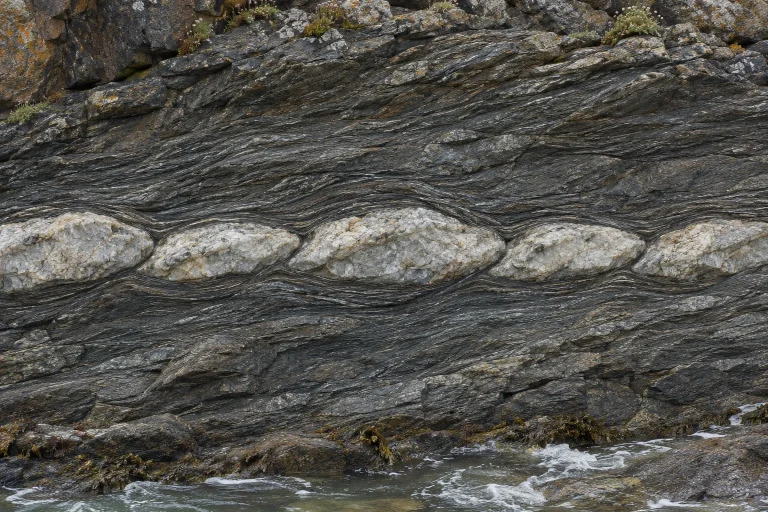
On a rock face in Alaska’s Kenai Fjords, a group of rounded basalt lobes looks as though someone tilted the whole pile sideways. In fact, the pile has tilted since the lava erupted. A pointed projection on the underside of one lobe fits into the space between two below it. That small detail lets geologists work out which way was down when the upper lobe was still soft. The shape began forming underwater while molten rock was trying to flow inside a skin that had already cooled.[1, 2]
Pillow lava forms when the surface of an advancing lobe chills rapidly against water. The hot interior can keep moving, inflating its crust or breaking out through a weak point. Each breakout puts fresh molten material in contact with water, making another chilled skin. A succession of these small advances builds a mound of overlapping lobes. The rounded outlines visible on an outcrop are often sections through connected tubes of rock.[1, 2, 3]
A solid outside and a moving centre
Water in contact with lava removes heat quickly. The outermost layer can cool so fast that its material solidifies as volcanic glass. A little farther inside, cooling is slower and small crystals can form. Cut across a well-preserved pillow and the texture may change from a dark glassy margin to a fine-grained interior. These two zones once belonged to the same increment of lava. Their different textures record how differently the edge and centre experienced contact with the water.[2, 5]
Picture a fresh lobe at the advancing end of a flow. A chilled rind forms, but lava is still arriving from behind. As the lobe expands, the surface must either stretch while it is soft or crack as it stiffens. Fresh lava can squeeze through an opening and make a new protrusion. Once that protrusion has its own crust it can repeat the process. The flow front moves a short distance even though much of its visible exterior is already dark and solid.[1, 3]
This is also why the word pillow can give a misleading picture of what the flow was doing. We see rounded objects resting against each other and imagine separate blobs dropping through the water like stones from a boat. Observations of active underwater lava showed how lobes could grow while attached to a supply of molten rock. In a rock wall a circular face might be the end-on view of a tube that extended some distance behind the surface now exposed.[1, 2]
The pile records the order of arrival
The first lobes on an uneven bottom occupy hollows and encounter obstacles. The next lobe may end up on top of two that have already acquired firm outlines. Its lower surface can sag into the gap between them. Geologists call the resulting downward projection a keel. The upper face, able to bulge into the water, often remains more smoothly rounded. Repeated examples give a way to identify the original top and bottom of a pile even after earth movements have tipped it.[2]
At Kenai Fjords the National Park Service shows pillows tilted by about 45 degrees. A photograph lets you compare the modern direction of gravity with the geometry of the lobes. Ask where a younger lobe could have rested and which hollows it filled when it arrived. A single rounded stone would give a poor answer. The fit between several neighbouring bodies gives a much better one, much as a line of fallen books can tell you more about their earlier arrangement than one book lying flat.[2]
What a camera on the seafloor can see
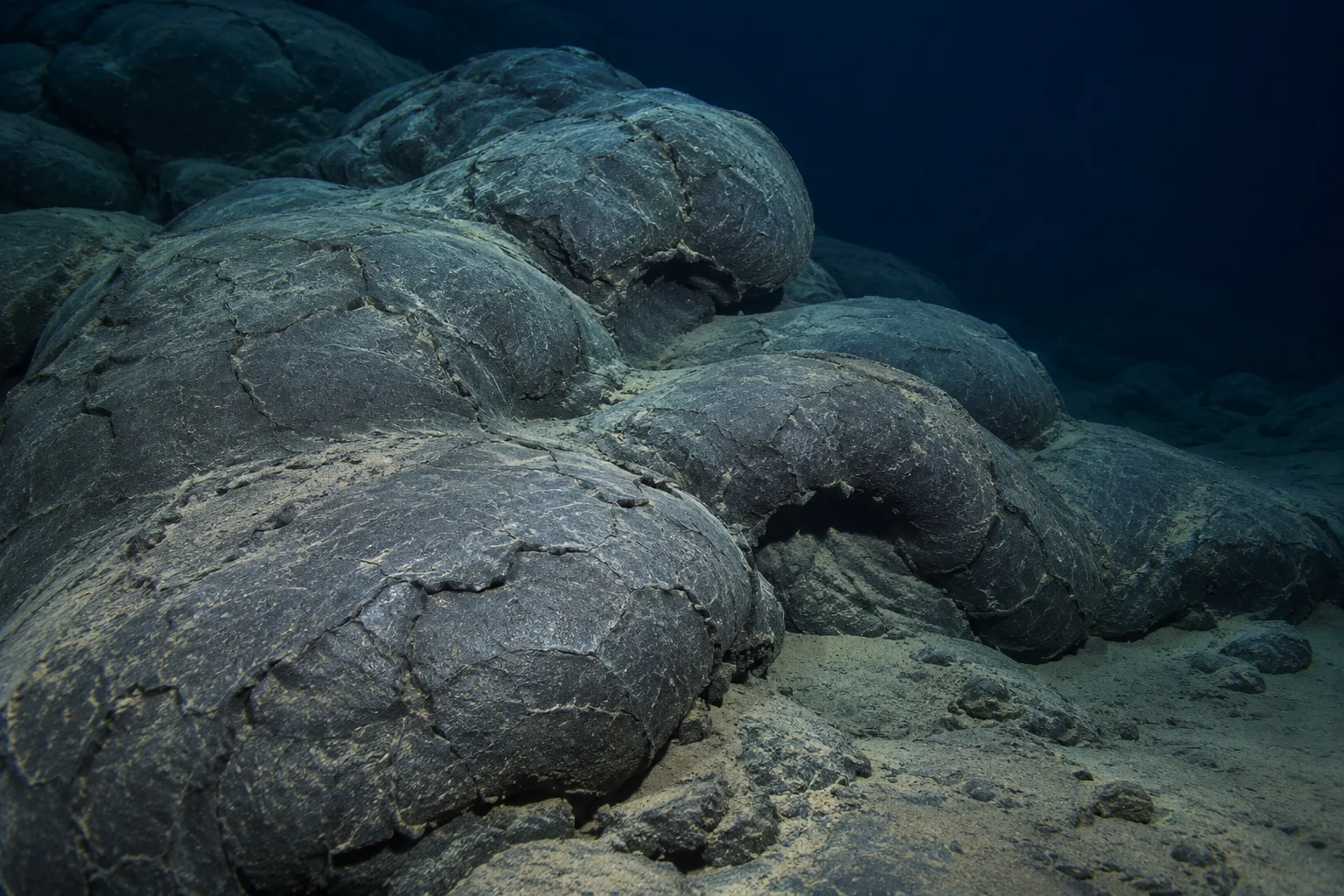
During NOAA’s deepwater exploration of the Marianas, a camera photographed a mound of pillow basalt. On some pillows, grooves called striations can form as new lava pushes through an already chilled opening. The surface thus preserves something about the movement that made it. A moving camera can also follow a ridge around a lobe, giving a fuller sense of its three-dimensional shape than a single slice in a roadcut would supply.[1, 4]
There are limits to what the exterior tells us. A groove can mark movement, and an intact chilled margin is evidence of rapid cooling. Neither observation on its own gives a unique depth for the water. Pillows form in oceans, but freshwater eruptions can produce them too. The Park Service describes pillow lava in Alaska’s Aniakchak caldera from a time when water filled the crater. Finding a pillow establishes a useful clue about conditions at the flow front. Identifying a particular ocean or lake requires the regional geology. Nearby sediment deposited in the same basin, or the outline of a former crater, can make a stronger case for where the water came from than the lava rind alone.[2, 3]
Why old pillow lava can look green
A newly exposed piece of basalt commonly looks dark. Ancient underwater basalt in California’s Marin Headlands can be greenish. Mineral-rich water moving through the rock helped alter some of its original minerals to chlorite and other green minerals. An old outcrop may therefore preserve the outline of a pillow much better than it preserves the colour of the fresh lava. Its colour and its shape can belong to different chapters of the same rock’s history.[2, 5]
Other openings inside the rock can acquire their own mineral fillings. A filled cavity and the surrounding fine-grained basalt needn’t have formed at the same moment. To reconstruct the sequence, a geologist asks what had to exist first. There had to be a lobe before it could acquire a chilled edge, a cavity before another mineral could fill it, and an assembled pile before the whole mass could tilt. A few centimetres of exposed rock can preserve evidence of several changes separated by enormous intervals of time.[2, 5]
The mound on the modern seafloor and the tilted outcrop in Alaska offer complementary views. Underwater images show intact surfaces still sitting where the flow came to rest. On land, erosion can cut straight through the lobes and expose their chilled margins and interiors. Together they account for a shape that once puzzled observers. A pillow of rock is the record of a moving interior, a cooling skin and the space that the preceding lobe left for the next one.[1, 2, 4]
Related reading
Sources
- US Geological Survey — Mechanism of formation of pillow lava
- National Park Service — Pillow basalts
- US Geological Survey — Don’t try to have a pillow fight with these pillows
- NOAA Ocean Exploration — Pillow lava
- Golden Gate National Recreation Area — Pillow basalt FAQ
Keep exploring.
One remarkable idea at a time—nature, science, history and beyond.
Last updated November 21, 2026.

Barnakle Editorial Team
Barnakle Editorial Team is the collective byline used for Barnakle’s editorial articles. The contributor profile explains the team identity and links to the publication’s editorial policies.
More from the editorial team →