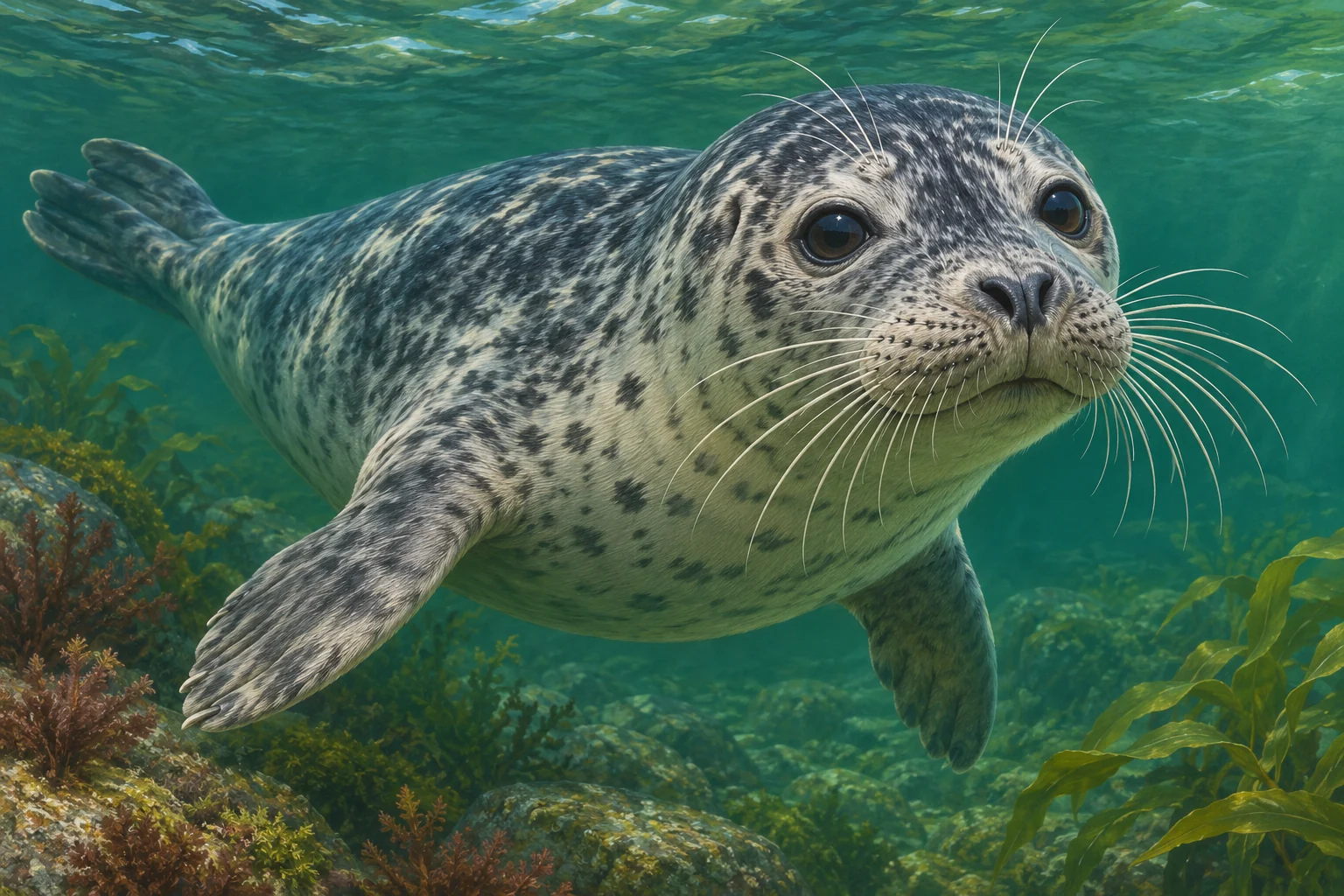
The miniature submarine was already gone when a blindfolded harbour seal set out after it. The seal could still follow the route it had taken through the water. In a 2001 experiment, researchers used a submarine precisely because they wanted a trail whose path they could control. It left a disturbance in the water, much as a swimming animal does. The seal had a way of sampling that disturbance without needing to see the object that made it. The instruments spread across its muzzle were its whiskers.[1]
A fish moving through a harbour does more than change its own position. Water flows around its body, its fins push water aside, and a beating tail sends rotating patches of water downstream. These disturbances can outlast the momentary flick of the tail. A seal that arrives later can encounter a fragment of the movement even when there is nothing ahead of its nose to touch. What survives is a pattern of water velocities. Its shape, strength and usefulness change as the water mixes.[1, 3]
A whisker that must move through water itself
The sensory problem becomes clearer if you imagine holding a thin rod out of a moving boat. Before any other boat passes, water flowing around your own rod is already making it vibrate. An incoming wake has to register against that background. A swimming seal faces the same problem many times across its muzzle. Each whisker has to respond to motions arriving from elsewhere while being swept by the relative flow produced by the seal’s own swimming.[2]
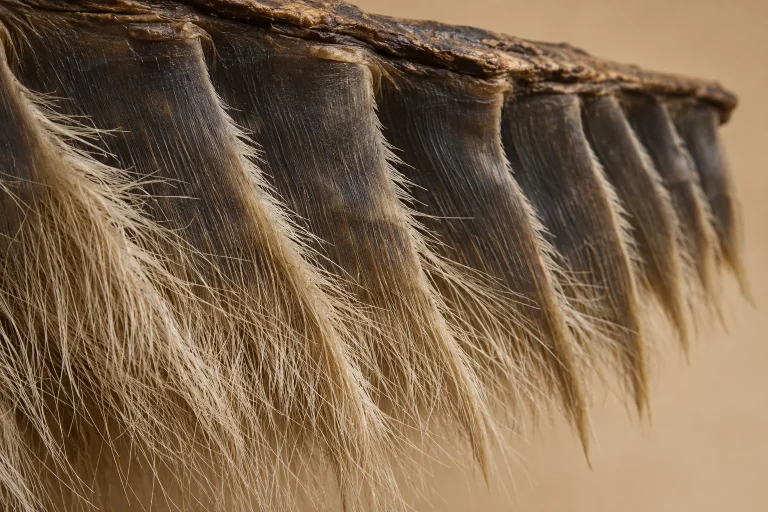
Harbour seal whiskers have an undulating outline along their length, quite different from a piece of uniform cylindrical wire. Researchers have measured the forces on whiskers in flowing water and modelled the flow around them. The undulations disrupt the regular shedding of vortices that can make a simpler shape oscillate strongly. Under the conditions tested, harbour seal whiskers experienced substantially smaller fluctuating forces than smoother sea lion whiskers. Reducing this source of motion makes changes in the surrounding flow easier to pick out.[2]
The array across the muzzle also changes what an incoming disturbance can do. A swirl reaching one side first need not bend every whisker in the same fashion at the same moment. A single whisker in a test channel lets researchers isolate the mechanics of one shaft before asking how the whole animal uses many such inputs together.[2, 3]
The comparison concerns the background generated at the sensor itself. A quiet whisker in steady flow can still bend or vibrate when a swirl reaches it. That distinction matters because a completely rigid, unresponsive probe would solve one problem by losing the signal as well. The useful property of the whisker is how it behaves in different flows. A close photograph of its shape suggests a function, but a test in moving water can show whether that shape actually changes the forces the whisker experiences.[2]
Which way did the swimmer go?
Detecting a disturbed patch of water is only the first part of the task. Imagine coming upon a line of footprints that gave no clue which end was the heel. You could follow the line yet head away from its maker. To ask whether a wake contains directional information, researchers drew a fin-like paddle from left to right or right to left in a tank. A blindfolded harbour seal then judged which way the paddle had moved. In these trials the animal could make that judgement with a trail as old as thirty-five seconds.[3]
The team also mapped the moving water. Pairs of rotating structures and the faster flow between them contained possible cues to direction. That separate measurement is important. A correct choice by the seal establishes that some usable information survived. A velocity map shows where a candidate cue existed. Neither observation lets the experimenter say exactly which part of the pattern the animal experienced as decisive on a particular trial. Thirty-five seconds describes this experiment and its conditions, rather than an expiry date for every fish trail in the sea.[3]
Following another seal around a turn
A different experiment gave a harbour seal a trail made by another swimming seal. Researchers recorded both routes, which let them compare where the trailing animal actually swam with the path its predecessor had taken. Sometimes the follower travelled close to the original course. In other runs it wove across the trail. A simple record of whether the animal reached the end would have missed that difference. A winding route, which might look like an error from above, could still keep returning the muzzle to the disturbance.[5]
Consider the difference between crossing a wake and travelling directly along it. A crossing briefly carries the whiskers through quiet water, into the disturbance and out again. Repeating the crossing samples its edges at successive places. Travelling along the wake can keep the animal in the signal for longer, but gives a different sequence of changes at the muzzle. The recorded paths permit both possibilities. They do not tell us that every turn was a deliberate sampling manoeuvre or that wild seals always follow prey along a single, well-defined track.[1, 5]
Is there information about the wake's maker?
In another controlled study, a seal encountered wakes left by paddles of different widths or shapes. The researchers tested whether the animal could distinguish pairs of objects from what each one left behind. Different objects can put different amounts of water into motion and produce different arrangements of swirls. Successful discrimination under those conditions is a step beyond simply detecting movement. It does not mean a harbour seal encountering a confused patch of wake in the ocean can name the species of fish that passed.[4]
A useful way to picture the sense is to change the setting of the original submarine experiment. Let a second swimmer cross the first track or let a current displace the whole pattern sideways. A trail may still carry evidence that something passed while becoming a less reliable guide to its present position. The whiskers touch the water at the muzzle. The next turn of the seal’s head has to be guided by information reaching that small patch of water now, however far ahead its quarry has travelled.[1, 3, 5]
Related reading
Sources
- Dehnhardt and colleagues — Hydrodynamic trail-following in harbor seals
- Hanke and colleagues — Harbor seal vibrissa morphology suppresses vortex-induced vibrations
- Wieskotten and colleagues — Determining the moving direction of an artificial fin
- Wieskotten and colleagues — Discrimination of wakes caused by different sizes and shapes
- Schulte-Pelkum and colleagues — Tracking of biogenic hydrodynamic trails in harbour seals
Keep exploring.
One remarkable idea at a time—nature, science, history and beyond.
Last updated November 21, 2026.

Barnakle Editorial Team
Barnakle Editorial Team is the collective byline used for Barnakle’s editorial articles. The contributor profile explains the team identity and links to the publication’s editorial policies.
More from the editorial team →