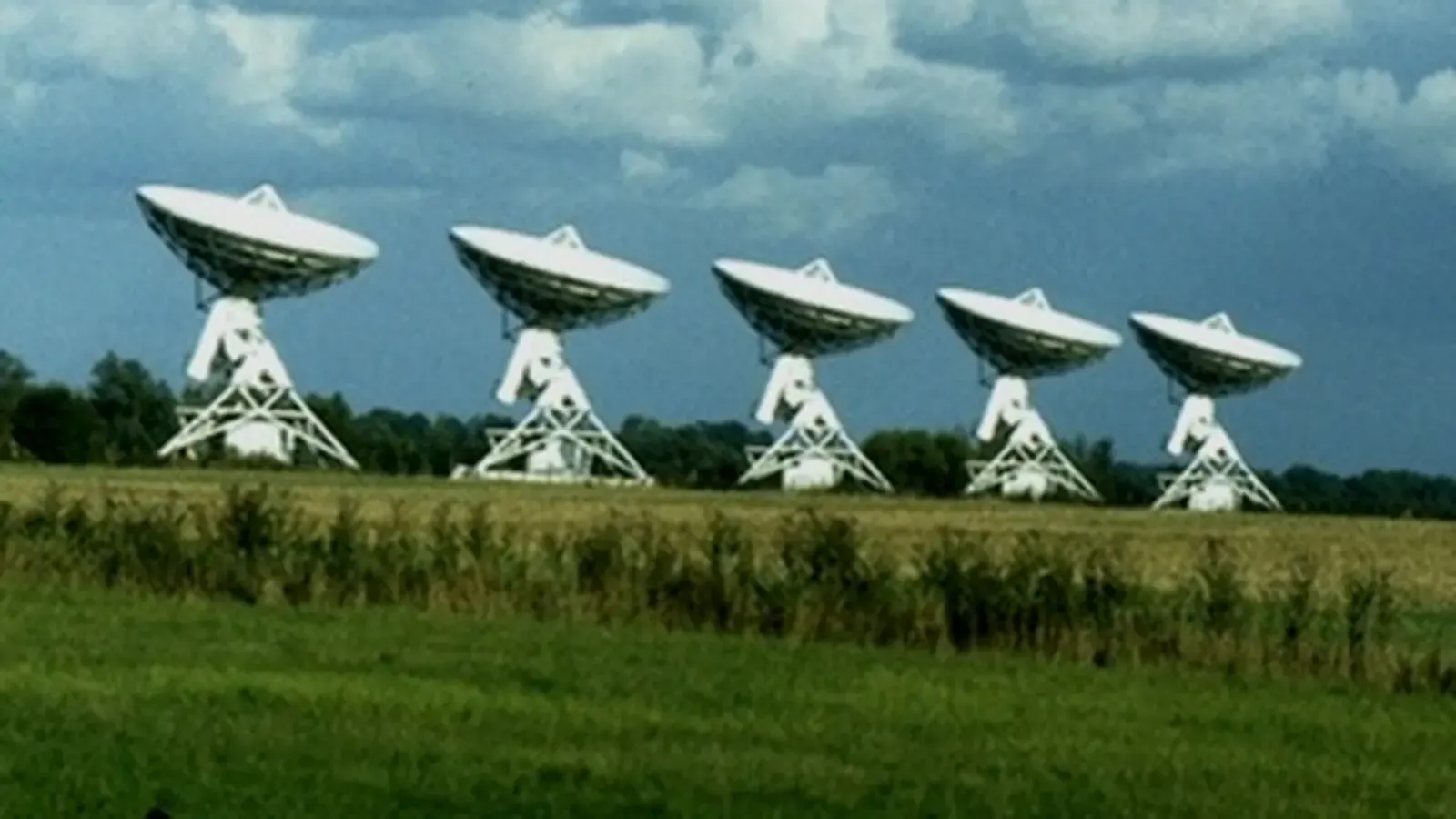
Several radio telescopes can observe the same source and combine their signals as an interferometer. The result can resolve details far smaller than an individual dish could distinguish. It is often described as a virtual giant telescope, but that phrase needs one qualification: the space between the dishes is not a filled collecting surface.
Interferometry gains information by comparing signals, not by making the empty ground behave like metal antenna.
A baseline measures a relationship
Radio waves from a distant source reach separated antennas with a geometric delay. Instrumental and timing effects must be accounted for when signals are compared. A correlator processes the recordings to measure their relationship.
Each antenna pair supplies a baseline. Different lengths and orientations probe different spatial information about the source. An array therefore gains more than repeated copies of the same measurement when it uses many antennas.
Separation controls the finest detail
At a given wavelength, longer baselines allow finer angular resolution. Observing at a shorter wavelength also changes the attainable resolution. NRAO explains why the relevant scale for an interferometer's finest detail is the baseline rather than merely the diameter of one antenna.
Sensitivity is a separate consideration. Moving two small antennas very far apart does not give them the collecting area of a solid dish spanning that distance. Faint structures still require enough signal, observing time and suitable instrumentation.
An image is assembled from incomplete samples
The measurements sample spatial information about the sky. Earth’s rotation changes projected baselines during an observation, allowing the array to obtain additional coverage. Processing then reconstructs an image consistent with the calibrated measurements.
The sampling is incomplete. This is why image reconstruction and checks for artefacts are essential rather than cosmetic final steps. A sharp-looking image can still omit information the array never measured.
Why short baselines matter too
A very extended array can reveal compact detail while being poorly suited to broad, smooth emission. NRAO's ALMA guidance explains how compact configurations and additional measurements supply information about larger structures.
A single dish or a compact set of smaller antennas can therefore complement a long-baseline array. The instruments are answering different parts of the imaging problem. Maximum separation is not automatically the best configuration for every source.
One instrument, several kinds of uncertainty
Atmospheric changes, antenna positions, clocks and instrumental responses can affect signal comparisons. Calibration observations help estimate these effects before the measurements are interpreted as sky structure.
The power of an interferometer comes from controlling those relationships across the array. It can turn separated antennas into an extraordinarily precise imaging system, while the resulting map remains limited by sensitivity, coverage and the quality of the calibration.
Explore a related question
How Starlight Reveals the Elements in Distant Suns
Sources and further reading
Keep exploring.
We’ll email you when the first edition is ready.
Last updated October 29, 2026.

Barnakle Editorial Team
Barnakle Editorial Team is the collective byline used for Barnakle’s editorial articles. The contributor profile explains the team identity and links to the publication’s editorial policies.
More from the editorial team →