Millions of microscopic contacts turn weak forces into remarkable grip
The grip is dry, directional and reversible
A gecko can attach in milliseconds, carry its body on vertical glass and peel a toe away without leaving obvious glue. That combination rules out many everyday analogies. The system depends on structure, contact mechanics and controlled movement rather than a permanently sticky secretion.
Toe pads are hierarchical structures
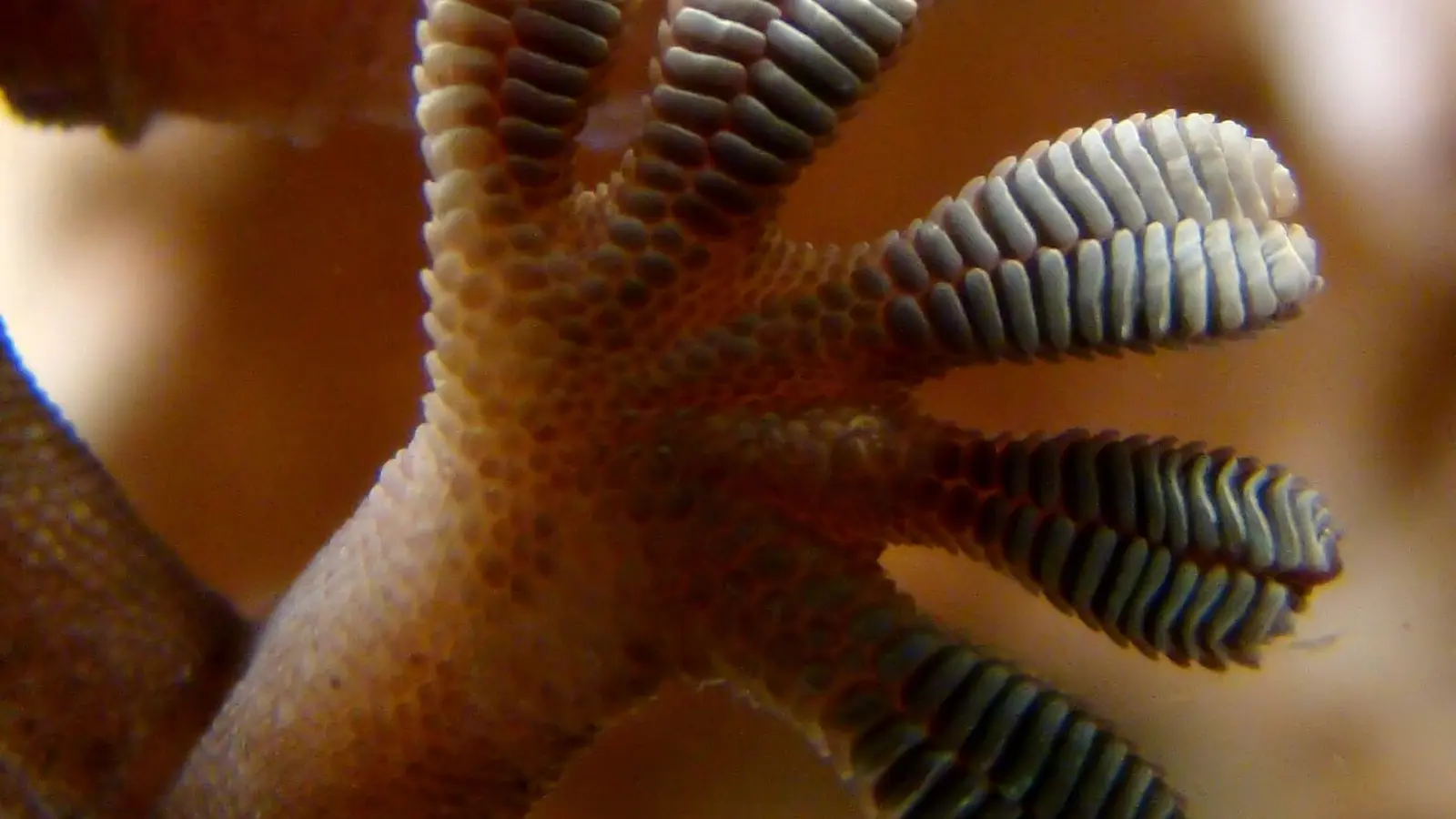
Under a microscope, adhesive pads carry rows of lamellae covered by setae. Each seta branches toward much finer terminal structures often called spatulae. Hierarchy allows the pad to conform across several scales, bringing a huge total area close to an uneven surface.
Weak forces add up
Atoms and molecules exhibit temporary fluctuations in charge distribution. At very small separations these produce van der Waals attractions. One interaction is tiny, but millions of nanoscale contacts acting together can generate substantial shear force. Close approach, not a mysterious biological glue, is the crucial condition.
Why ordinary skin cannot do the same
A smooth-looking wall is rough at microscopic scales. A flat, stiff surface touches only the highest points. Flexible branching hairs bend and distribute load, allowing far more tips to approach closely. Contact splitting also helps prevent one local defect from causing the entire pad to fail.
Attachment is directional
Setae are angled and respond strongly when loaded in a preferred direction. A gecko places its toes, drags them slightly and applies shear so many tips engage. Directionality supplies grip when needed while preventing the animal from becoming permanently trapped by its own feet.
Peeling makes release easy
Detachment begins by changing toe angle and peeling from an edge. Peeling concentrates separation at a moving front rather than requiring every contact to break simultaneously. Geckos hyperextend their toes during rapid running, a motion that coordinates attachment and release step by step.
It is not suction
Suction requires a sealed pressure difference. Gecko pads still work in conditions and on surfaces inconsistent with suction, and their microscopic architecture has no forest of tiny sealed cups. Experiments measuring single hairs and whole toes support contact-force explanations instead.
It is not ordinary glue
Adhesive geckos generally do not coat each step with a wet, tacky film. Dry adhesion avoids curing time and residue. Some animals use secretions in other adhesive systems, so the distinction should not be generalized to every climbing species or even every lizard.
Water changes the problem
Humidity and wet surfaces can alter both material properties and contact. Results depend on species, substrate and whether water forms a film that blocks close approach. Some geckos retain impressive performance in humid habitats, but a submerged or contaminated pad is not equivalent to clean dry glass.
How feet stay clean
Particles can adhere more strongly to a surface than to the toe as the gecko walks, allowing passive self-cleaning. Repeated steps and changes in contact geometry help shed dirt. Self-cleaning is effective, not perfect; oils and certain contaminants can reduce performance.
Different geckos use different strategies
Adhesive toe pads evolved and were lost multiple times within gecko lineages. Habitat, body size and locomotion influence pad form. Some species climb smooth leaves or rock, while others live mainly on the ground and lack elaborate pads. There is no single universal gecko foot.
How researchers measure a seta
Scientists isolate setae or fabricate probes, control angle and preload, then measure normal and shear forces. Electron microscopy reveals branching geometry. Whole-animal experiments test whether mechanisms inferred at the nanoscale still explain real running, turning and recovery on varied surfaces.
What engineers copy
Gecko-inspired adhesives aim for reusable dry grip in robots, manufacturing and medical devices. Successful designs copy principles—contact splitting, compliance, directionality and peeling—rather than merely imitating a toe’s appearance. Scaling and contamination remain serious engineering challenges.
Limits reveal the mechanism
Very rough surfaces reduce the number of contacts; soft or dusty materials behave differently from clean glass. Load direction matters, and performance changes with pad area and body orientation. These predictable failures help distinguish the accepted mechanism from vague claims that geckos can stick to anything.
Key takeaways
- Many geckos cling without glue or suction cups. Microscopic hairs called setae branch into nanoscale tips that make extremely close contact with a surface. Vast numbers of weak van der Waals interactions combine to provide useful adhesion, while toe motion lets the animal attach and release rapidly.
Continue exploring
Sources and further reading
Keep exploring.
One remarkable idea at a time—nature, science, history and beyond.
Last updated October 27, 2026.

Barnakle Editorial Team
Barnakle Editorial Team is the collective byline used for Barnakle’s editorial articles. The contributor profile explains the team identity and links to the publication’s editorial policies.
More from the editorial team →