
Gravity deforms deep ice and drives sliding over rock, sediment and meltwater
The short answer
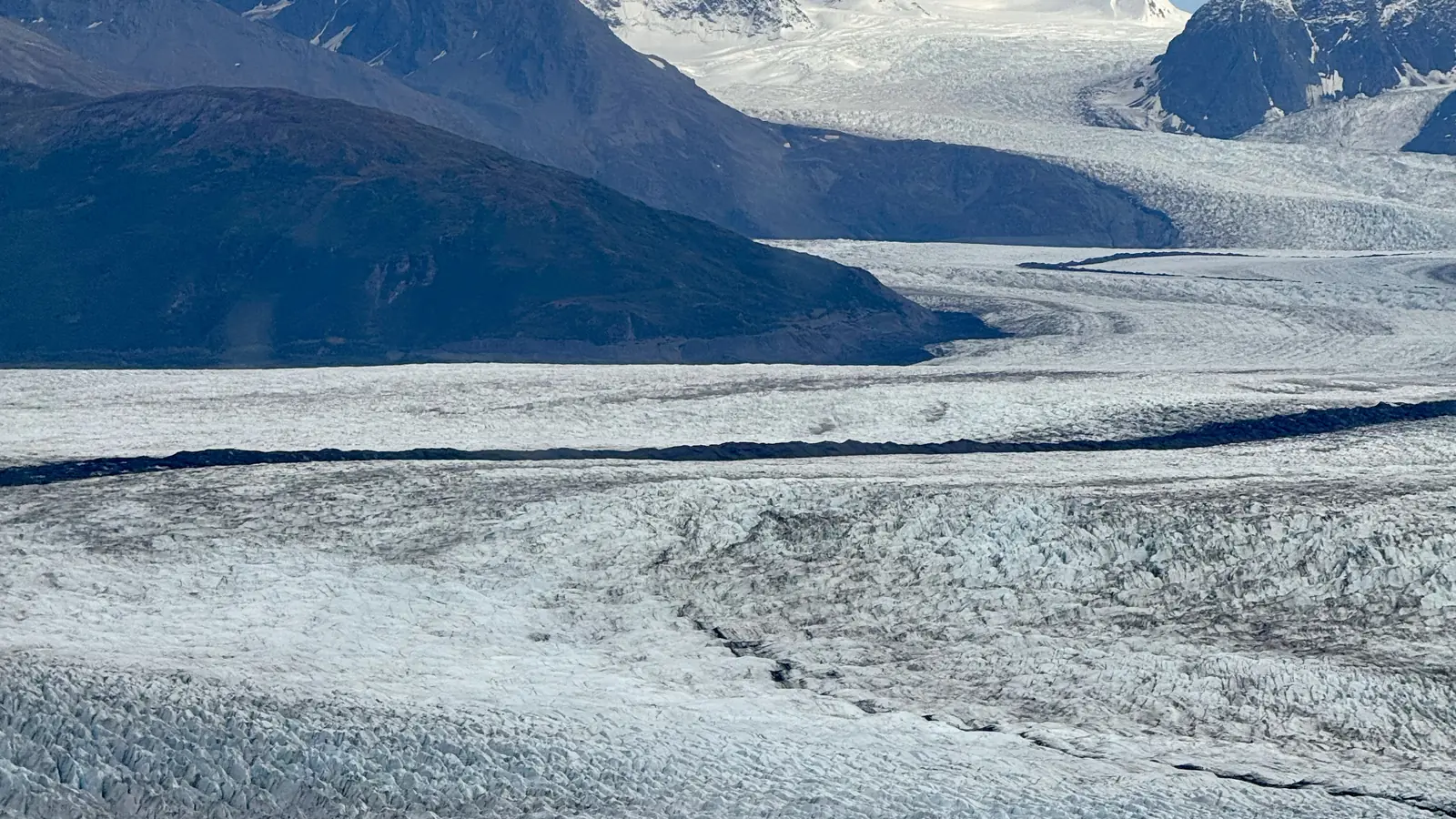
Glaciers move because gravity pulls their enormous mass downhill. Ice deforms internally as crystals change shape and slide past one another, while many glaciers also slide over their beds or deform water-rich sediment beneath them. Speed varies from centimetres per day to much faster surges and ice streams, depending on slope, thickness, temperature, bed conditions and meltwater pressure.
A glacier can look fixed because its motion is slow compared with a river, yet the ice is continually flowing from an accumulation zone toward lower elevations or the coast. Snowfall adds mass, melting and calving remove it, and the balance among those processes determines whether the terminus advances or retreats. Movement and retreat are therefore not opposites.
Gravity supplies the driving stress
A thick sloping body of ice has weight directed downslope. Greater thickness and surface slope generally increase the stress available to deform ice and overcome resistance.
Understanding Gravity supplies the driving stress requires separating the immediate mechanism from the conditions that make it stronger, weaker or easier to observe. Researchers measure those variables independently, compare natural examples and test whether the same explanation predicts new results. This turns a plausible story into an evidence-based account.
The evidence for Gravity supplies the driving stress comes from methods that fail in different ways. Direct observation establishes what occurs, instruments quantify timing or structure, experiments isolate candidate causes and models test whether known rules reproduce the pattern. Agreement across methods is more persuasive than repetition of one memorable example.
Context also matters for Gravity supplies the driving stress. Scale, species, location, temperature, geometry and measurement limits can change the result without overturning the underlying process. Careful reporting preserves that variation, states uncertainty and prevents a useful explanation from becoming an exaggerated universal rule.
Ice deforms as a crystalline solid
Under sustained stress, ice crystals change shape, rotate and recrystallize. This viscous creep is fastest where pressure and temperature are high, usually deeper in the glacier.
Understanding Ice deforms as a crystalline solid requires separating the immediate mechanism from the conditions that make it stronger, weaker or easier to observe. Researchers measure those variables independently, compare natural examples and test whether the same explanation predicts new results. This turns a plausible story into an evidence-based account.
The evidence for Ice deforms as a crystalline solid comes from methods that fail in different ways. Direct observation establishes what occurs, instruments quantify timing or structure, experiments isolate candidate causes and models test whether known rules reproduce the pattern. Agreement across methods is more persuasive than repetition of one memorable example.
Context also matters for Ice deforms as a crystalline solid. Scale, species, location, temperature, geometry and measurement limits can change the result without overturning the underlying process. Careful reporting preserves that variation, states uncertainty and prevents a useful explanation from becoming an exaggerated universal rule.
The surface often moves fastest
Friction and roughness resist motion near the bed and valley walls. Ice toward the centre and surface commonly travels farther, stretching and shearing the glacier.
Understanding The surface often moves fastest requires separating the immediate mechanism from the conditions that make it stronger, weaker or easier to observe. Researchers measure those variables independently, compare natural examples and test whether the same explanation predicts new results. This turns a plausible story into an evidence-based account.
The evidence for The surface often moves fastest comes from methods that fail in different ways. Direct observation establishes what occurs, instruments quantify timing or structure, experiments isolate candidate causes and models test whether known rules reproduce the pattern. Agreement across methods is more persuasive than repetition of one memorable example.
Context also matters for The surface often moves fastest. Scale, species, location, temperature, geometry and measurement limits can change the result without overturning the underlying process. Careful reporting preserves that variation, states uncertainty and prevents a useful explanation from becoming an exaggerated universal rule.
Warm-based glaciers can slide
Where the base reaches the pressure-melting point, liquid water helps separate ice from bedrock and modifies friction. Sliding occurs around obstacles and over cavities rather than like a block on a perfectly smooth floor.
Understanding Warm-based glaciers can slide requires separating the immediate mechanism from the conditions that make it stronger, weaker or easier to observe. Researchers measure those variables independently, compare natural examples and test whether the same explanation predicts new results. This turns a plausible story into an evidence-based account.
The evidence for Warm-based glaciers can slide comes from methods that fail in different ways. Direct observation establishes what occurs, instruments quantify timing or structure, experiments isolate candidate causes and models test whether known rules reproduce the pattern. Agreement across methods is more persuasive than repetition of one memorable example.
Context also matters for Warm-based glaciers can slide. Scale, species, location, temperature, geometry and measurement limits can change the result without overturning the underlying process. Careful reporting preserves that variation, states uncertainty and prevents a useful explanation from becoming an exaggerated universal rule.
Cold-based ice can freeze to its bed
Polar or high-altitude glaciers may remain below melting temperature throughout. They move mainly by internal deformation and can preserve ancient surfaces beneath them.
Understanding Cold-based ice can freeze to its bed requires separating the immediate mechanism from the conditions that make it stronger, weaker or easier to observe. Researchers measure those variables independently, compare natural examples and test whether the same explanation predicts new results. This turns a plausible story into an evidence-based account.
The evidence for Cold-based ice can freeze to its bed comes from methods that fail in different ways. Direct observation establishes what occurs, instruments quantify timing or structure, experiments isolate candidate causes and models test whether known rules reproduce the pattern. Agreement across methods is more persuasive than repetition of one memorable example.
Context also matters for Cold-based ice can freeze to its bed. Scale, species, location, temperature, geometry and measurement limits can change the result without overturning the underlying process. Careful reporting preserves that variation, states uncertainty and prevents a useful explanation from becoming an exaggerated universal rule.
Subglacial sediment can deform
Some glaciers rest on water-rich till instead of solid rock. Shearing that sediment can contribute substantially to motion and transport large quantities of debris.
Understanding Subglacial sediment can deform requires separating the immediate mechanism from the conditions that make it stronger, weaker or easier to observe. Researchers measure those variables independently, compare natural examples and test whether the same explanation predicts new results. This turns a plausible story into an evidence-based account.
The evidence for Subglacial sediment can deform comes from methods that fail in different ways. Direct observation establishes what occurs, instruments quantify timing or structure, experiments isolate candidate causes and models test whether known rules reproduce the pattern. Agreement across methods is more persuasive than repetition of one memorable example.
Context also matters for Subglacial sediment can deform. Scale, species, location, temperature, geometry and measurement limits can change the result without overturning the underlying process. Careful reporting preserves that variation, states uncertainty and prevents a useful explanation from becoming an exaggerated universal rule.
Meltwater changes pressure
Water reaching the bed can temporarily lift ice or reduce effective pressure, accelerating sliding. Efficient drainage channels may later lower pressure and slow the glacier again.
Understanding Meltwater changes pressure requires separating the immediate mechanism from the conditions that make it stronger, weaker or easier to observe. Researchers measure those variables independently, compare natural examples and test whether the same explanation predicts new results. This turns a plausible story into an evidence-based account.
The evidence for Meltwater changes pressure comes from methods that fail in different ways. Direct observation establishes what occurs, instruments quantify timing or structure, experiments isolate candidate causes and models test whether known rules reproduce the pattern. Agreement across methods is more persuasive than repetition of one memorable example.
Context also matters for Meltwater changes pressure. Scale, species, location, temperature, geometry and measurement limits can change the result without overturning the underlying process. Careful reporting preserves that variation, states uncertainty and prevents a useful explanation from becoming an exaggerated universal rule.
Crevasses form where ice stretches
The upper tens of metres behave more brittlely than deeper ice. When surface strain exceeds the ice’s ability to deform smoothly, cracks open across or along the flow.
Understanding Crevasses form where ice stretches requires separating the immediate mechanism from the conditions that make it stronger, weaker or easier to observe. Researchers measure those variables independently, compare natural examples and test whether the same explanation predicts new results. This turns a plausible story into an evidence-based account.
The evidence for Crevasses form where ice stretches comes from methods that fail in different ways. Direct observation establishes what occurs, instruments quantify timing or structure, experiments isolate candidate causes and models test whether known rules reproduce the pattern. Agreement across methods is more persuasive than repetition of one memorable example.
Context also matters for Crevasses form where ice stretches. Scale, species, location, temperature, geometry and measurement limits can change the result without overturning the underlying process. Careful reporting preserves that variation, states uncertainty and prevents a useful explanation from becoming an exaggerated universal rule.
Icefalls mark steep acceleration
Over abrupt bedrock steps, ice extends, fractures and moves through a chaotic field of seracs and crevasses. Downstream compression can close some fractures.
Understanding Icefalls mark steep acceleration requires separating the immediate mechanism from the conditions that make it stronger, weaker or easier to observe. Researchers measure those variables independently, compare natural examples and test whether the same explanation predicts new results. This turns a plausible story into an evidence-based account.
The evidence for Icefalls mark steep acceleration comes from methods that fail in different ways. Direct observation establishes what occurs, instruments quantify timing or structure, experiments isolate candidate causes and models test whether known rules reproduce the pattern. Agreement across methods is more persuasive than repetition of one memorable example.
Context also matters for Icefalls mark steep acceleration. Scale, species, location, temperature, geometry and measurement limits can change the result without overturning the underlying process. Careful reporting preserves that variation, states uncertainty and prevents a useful explanation from becoming an exaggerated universal rule.
Surges are exceptional episodes
A small fraction of glaciers periodically accelerate for months or years because of changes in basal water, sediment or internal thermal conditions. A surge is not simply the daily response to warm weather.
Understanding Surges are exceptional episodes requires separating the immediate mechanism from the conditions that make it stronger, weaker or easier to observe. Researchers measure those variables independently, compare natural examples and test whether the same explanation predicts new results. This turns a plausible story into an evidence-based account.
The evidence for Surges are exceptional episodes comes from methods that fail in different ways. Direct observation establishes what occurs, instruments quantify timing or structure, experiments isolate candidate causes and models test whether known rules reproduce the pattern. Agreement across methods is more persuasive than repetition of one memorable example.
Context also matters for Surges are exceptional episodes. Scale, species, location, temperature, geometry and measurement limits can change the result without overturning the underlying process. Careful reporting preserves that variation, states uncertainty and prevents a useful explanation from becoming an exaggerated universal rule.
Tidewater glaciers respond to the ocean
Floating or near-floating fronts lose ice through calving and submarine melting. Reduced resistance at the front can transmit acceleration far inland.
Understanding Tidewater glaciers respond to the ocean requires separating the immediate mechanism from the conditions that make it stronger, weaker or easier to observe. Researchers measure those variables independently, compare natural examples and test whether the same explanation predicts new results. This turns a plausible story into an evidence-based account.
The evidence for Tidewater glaciers respond to the ocean comes from methods that fail in different ways. Direct observation establishes what occurs, instruments quantify timing or structure, experiments isolate candidate causes and models test whether known rules reproduce the pattern. Agreement across methods is more persuasive than repetition of one memorable example.
Context also matters for Tidewater glaciers respond to the ocean. Scale, species, location, temperature, geometry and measurement limits can change the result without overturning the underlying process. Careful reporting preserves that variation, states uncertainty and prevents a useful explanation from becoming an exaggerated universal rule.
Retreat describes the terminus, not every parcel
A retreating glacier still flows downhill. Its end moves backward when melting and calving remove ice faster than flow delivers replacement ice.
Understanding Retreat describes the terminus, not every parcel requires separating the immediate mechanism from the conditions that make it stronger, weaker or easier to observe. Researchers measure those variables independently, compare natural examples and test whether the same explanation predicts new results. This turns a plausible story into an evidence-based account.
The evidence for Retreat describes the terminus, not every parcel comes from methods that fail in different ways. Direct observation establishes what occurs, instruments quantify timing or structure, experiments isolate candidate causes and models test whether known rules reproduce the pattern. Agreement across methods is more persuasive than repetition of one memorable example.
Context also matters for Retreat describes the terminus, not every parcel. Scale, species, location, temperature, geometry and measurement limits can change the result without overturning the underlying process. Careful reporting preserves that variation, states uncertainty and prevents a useful explanation from becoming an exaggerated universal rule.
Common misconceptions
Glaciers are not motionless ice cubes, and retreat does not mean the ice reverses direction uphill. Meltwater can speed sliding, but more water does not always mean faster flow because an organized drainage system can reduce basal pressure. One mechanism does not dominate every glacier.
A concise explanation is useful only when it preserves the causal chain. It becomes misleading when it substitutes a familiar label for a mechanism, confuses association with cause or extends evidence beyond the conditions actually studied.
How scientists know
Scientists stake positions on the surface, use GPS and satellite radar to measure velocity, drill boreholes to the bed and map internal layers with radar. Seismic instruments detect basal motion, while laboratory experiments and field sensors test ice deformation, water pressure and sediment friction.
No single measurement carries the conclusion. Observations, experiments, physical theory and repeated records provide independent checks, while disagreement points to an uncontrolled variable or a question that still needs a better test.
Frequently asked questions
How fast can a glacier move?
Rates range from very slow creep to metres per day or more in fast ice streams and short-lived surges.
Why does glacier ice look blue?
Dense ice absorbs more red wavelengths while transmitting or scattering more blue light through a long path.
Do glaciers move in winter?
Yes. Internal deformation and basal motion continue, although seasonal meltwater can change speed.
What causes a glacier to advance?
The terminus advances when incoming ice flow exceeds losses from melting and calving over time.
Can a glacier flow uphill?
Local bed geometry can rise, but the glacier’s overall motion is driven down the gradient of its ice surface and gravitational potential.
Key takeaways
- Gravity drives internal ice deformation.
- Sliding and sediment deformation can add substantial motion.
- Water pressure can accelerate or slow basal flow.
- A glacier may flow forward while its terminus retreats.
Continue exploring
Sources and further reading
Keep exploring.
One remarkable idea at a time—nature, science, history and beyond.
Sources and further reading
Barnakle uses credible primary and authoritative sources wherever possible.
- USGS — Glaciers: Things to Know
- https://www.usgs.gov/water-science-school/science/glaciers-things-know
- USGS — Geology of Glacier National Park
- https://www.usgs.gov/geology-and-ecology-of-national-parks/geology-glacier-national-park
- USGS — Glacier sliding and mass balance
- https://pubs.usgs.gov/publication/70015528
- USGS — Subglacial water channels
- https://www.usgs.gov/publications/rothlisberger-channel-theory-its-origins-and-consequences
Last reviewed October 2, 2026.

Barnakle Editorial Team
A member of the Barnakle editorial team, exploring remarkable ideas with clarity, curiosity and care.
More from this author →