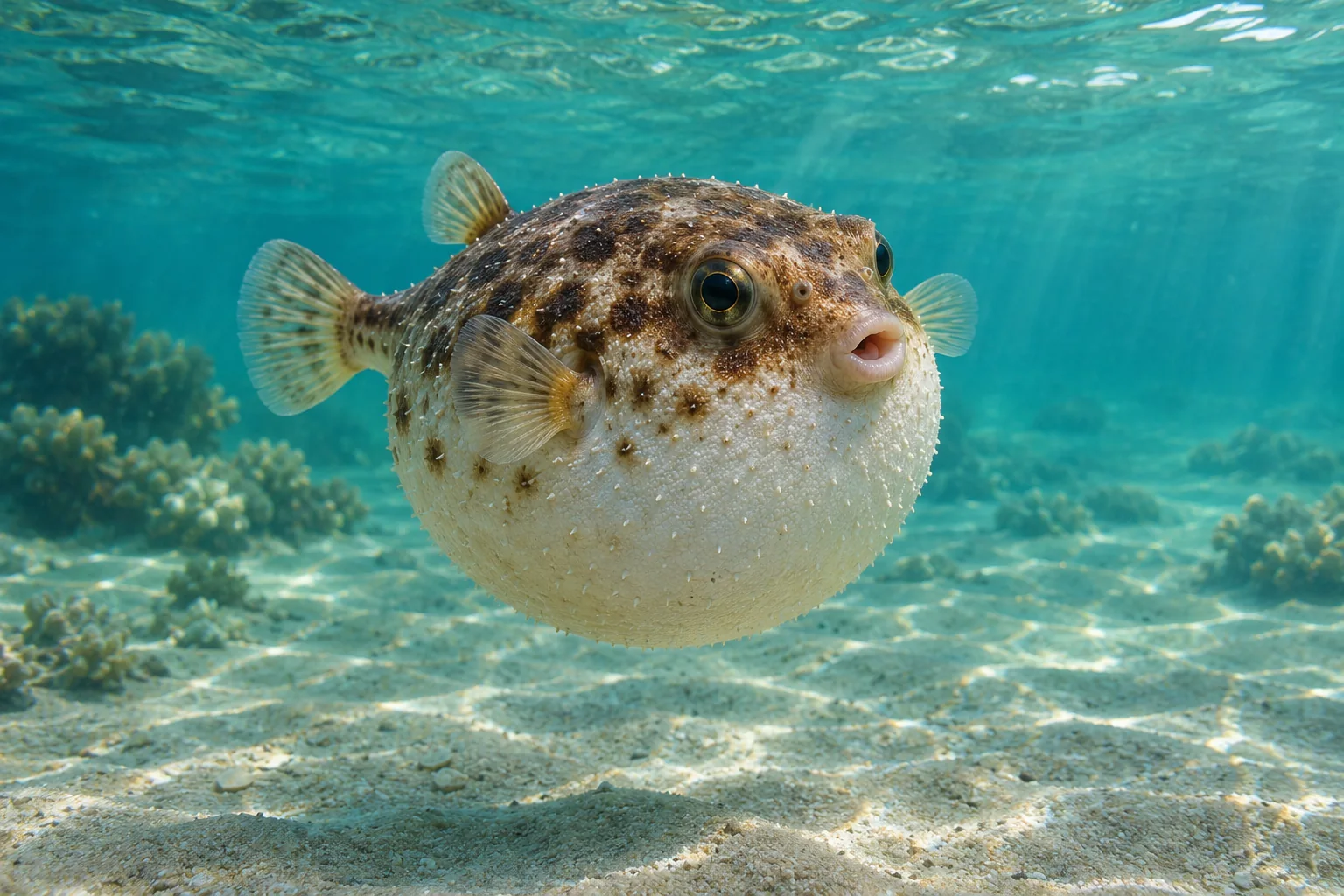
Pufferfish inflate by pumping water through the mouth into an expandable stomach. As the stomach fills, the body becomes wider and rounder, making the fish more difficult for a predator to swallow. It is a rapid change in shape, powered by muscles and accommodated by specialized tissues, rather than a fish simply taking a very deep breath. [1, 2]
The familiar balloon shape hides several separate jobs: move water into the right compartment, keep it there, make room for the extra volume and continue obtaining oxygen. Studying those jobs explains both why inflation is effective and why it has costs.
What fills an inflated pufferfish?
Underwater, the material filling the expandable stomach is water from the surrounding environment. The water has to enter through the mouth, but it does not simply accumulate in the mouth or inflate the gills. The stomach provides the main reservoir. Muscular closures in the digestive tract help retain the swallowed water while the fish stays distended. [1, 5]
That location matters. A fish can move water for more than one purpose: water passing across gills supplies oxygen, whereas water swallowed into the inflation reservoir increases body volume. Seeing water enter the mouth does not, by itself, tell you which route it follows.
Some inflation-capable fishes can also take in air when out of water. That possibility has helped create the misleading idea that an underwater puffer always fills with air. The normal underwater explanation requires no gas production or hidden compressed-air supply: the surrounding water is available to be pumped inside.
How the mouth becomes a pump
The mouth cavity, also called the buccal cavity, changes volume through coordinated movements of the head skeleton and associated muscles. Expansion draws water in; compression drives it onward. A study of Takifugu obscurus describes this cavity acting as a pump during inflation and identifies specialized muscles and nerve connections involved in the response. [2]
The sequence must control direction as well as force. Merely squeezing water back out through an open mouth would not fill the stomach. Coordinated movements and closures route repeated mouthfuls into the expandable compartment. Comparative research on inflation behavior examines how this pumping action relates to other water-moving behaviors in these fishes. [4]
An ordinary hand pump offers a useful analogy for one part of the process: changing chamber volume moves fluid, but controlling the path determines where that fluid goes. The fish supplies both the moving chamber and the biological mechanisms that guide the flow. The analogy does not mean that its head contains manufactured one-way valves.
How can the body stretch so much?
Inflation requires more than a large stomach. Surrounding skin, body spaces and skeletal arrangements must allow that stomach to expand. Detailed anatomical work on the balloonfish, Diodon holocanthus, found a highly extensible, folded stomach and a large, expandable abdominal space. Its body can accommodate a dramatic increase in volume without every tissue stretching by the same amount. [3]
The skin in that species has wavy collagen fibers. Initially, extension can straighten those waves; at larger strains, the fibers themselves bear more load and the skin stiffens. This is a more precise explanation than describing the animal as an unlimited rubber balloon. Its tissues have a changing mechanical response and a finite range of expansion. [3]
Different inflation-capable species have different shapes and tissue arrangements. A measurement from one balloonfish species should not become a universal rule for every pufferfish. Even the words used to describe growth need care: doubling a width is a different claim from doubling volume.
Are pufferfish and porcupinefish the same?
They are related, but the common names cover different fish families. True pufferfishes belong to Tetraodontidae; porcupinefishes belong to Diodontidae. Both include fishes that inflate, but the conspicuous long spines seen in many popular photographs are especially associated with porcupinefishes. The balloonfish used in the anatomical study is a member of the latter family. [3, 6, 7]
Florida Museum profiles describe how water intake expands the body and makes the spines of balloonfish and porcupinefish stand outward. Those spines are part of the defensive surface, rather than separate air-filled structures. A round fish with short prickles and a sphere surrounded by long spikes should therefore not be treated as identical anatomical examples. [6, 7]
Why a larger shape discourages predators
A predator that swallows prey whole faces a basic size constraint: its mouth and throat must accommodate the prey. Inflation changes that relationship after an encounter begins. A fish that appeared small enough to seize can become a much more awkward object to handle. Outward-pointing spines can add another obstacle in species that possess them. [4, 6, 7]
This is a mechanical defense, not a guarantee of survival. The response has to occur in time and changes what the predator must overcome. Describing its function does not require imagining that the fish calculates a predator’s mouth size or consciously decides on a geometric target.
It also helps to distinguish defense from routine body shape. The inflated outline is a temporary state produced by active water movement. It is not evidence that the animal normally stores a large internal balloon of air.
Can pufferfish breathe while inflated?
At least in the black-saddled pufferfish, Canthigaster valentini, the answer is clearly yes. Researchers measured oxygen uptake during inflation and found that the fish continued to take up oxygen, principally through the gills. Their results challenged the older suggestion that inflation necessarily involves holding the breath and relying on oxygen exchange through the skin. [5]
Keeping inflation water in the digestive tract helps explain how gill function can remain separate. The swallowed water is not simply sealing off every route involved in respiration. The result is strong evidence about this studied species; it should not be rewritten as a measurement of every pufferfish under every condition. [5]
Barnakle’s guide to how fish breathe underwater explains the ordinary gill process behind this surprising finding. Another different solution to life at the water boundary appears in how water striders walk on water.
Inflation still has an energy cost
Being able to breathe does not make the defense effortless. The AIMS research team distinguished the act of remaining inflated from the rapid activity before inflation and the work of gulping water. Those preceding movements and the inflation event can be energetically demanding, with recovery continuing afterward. [1]
This distinction prevents a common mistake: a fish that can obtain oxygen while round is not necessarily ready to repeat the whole escape sequence immediately. A dramatic change visible for seconds can have consequences that last longer than the visible event.
Questions about pufferfish inflation
Do pufferfish inflate their swim bladder?
The defensive inflation described here uses an expandable stomach. It should not be confused with changing gas volume in a swim bladder. [1, 3]
Do all inflated fishes have long spines?
No. Skin armament differs among these related fishes. Long, conspicuous spines on a porcupinefish are not a universal feature of every true pufferfish. [6, 7]
Does inflation prove that a pufferfish is holding its breath?
No. Direct oxygen measurements in black-saddled pufferfish showed continued gill oxygen uptake while inflated. [5]
What is the main idea to remember?
The transformation brings a fluid pump, an expandable reservoir and specialized body tissues together. The fish becomes a harder shape to swallow by moving water into itself.
Sources and further reading
Pufferfish references checked November 14, 2026. Anatomy records used only as abstracts are labeled below. Restricted full texts were not reviewed.
- Australian Institute of Marine Science — Do pufferfish hold their breath while inflated? (research team explanation)
- Neural basis of the stress response in a pufferfish, Takifugu obscurus (2014) — research abstract
- Brainerd (1994) — Pufferfish inflation: Functional morphology of postcranial structures in Diodon holocanthus — research abstract
- Wainwright and Turingan (1997) — Evolution of pufferfish inflation behavior — research paper
- McGee and Clark (2014) — All puffed out: do pufferfish hold their breath while inflated? — research paper
- Florida Museum — Balloonfish (Diodon holocanthus)
- Florida Museum — Porcupinefish (Diodon hystrix)
Keep exploring.
One remarkable idea at a time—nature, science, history and beyond.
Last updated November 16, 2026.

Barnakle Editorial Team
Barnakle Editorial Team is the collective byline used for Barnakle’s editorial articles. The contributor profile explains the team identity and links to the publication’s editorial policies.
More from the editorial team →